

 English
 Español
 Deutsch
 中文简体
中文简体
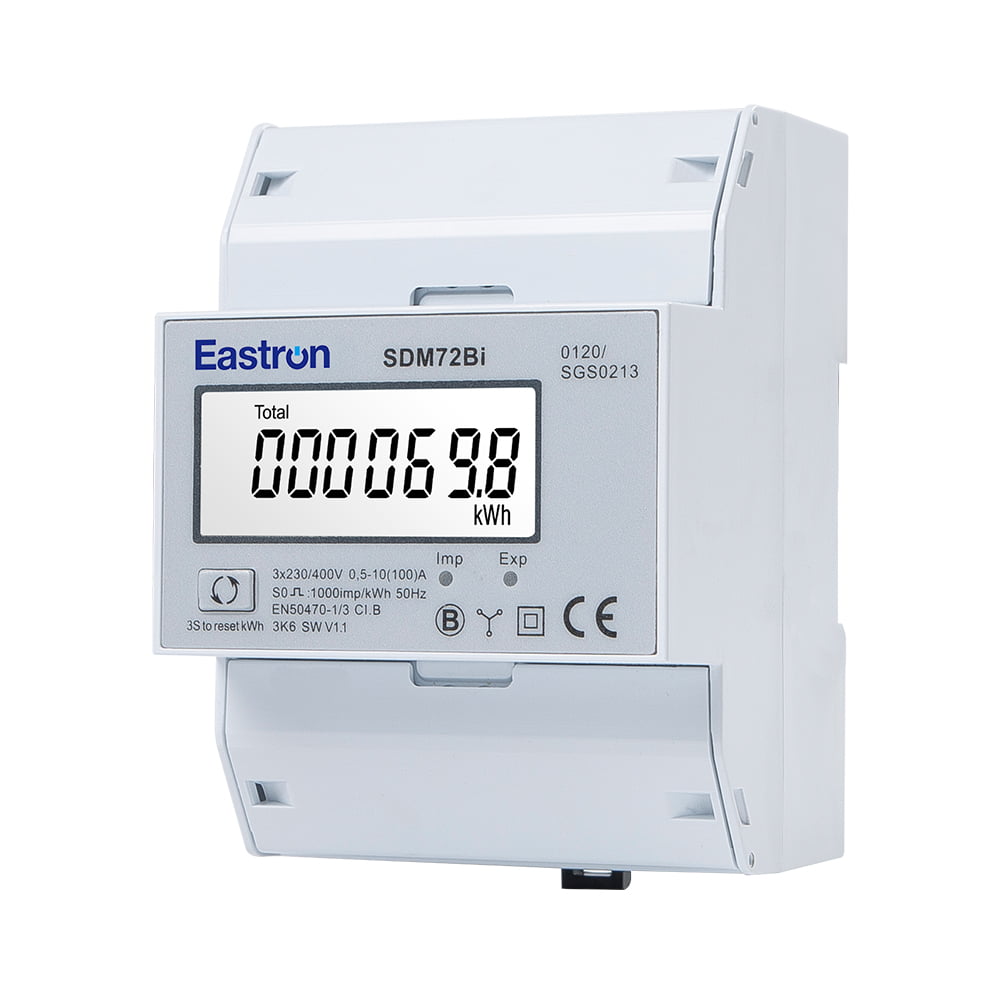
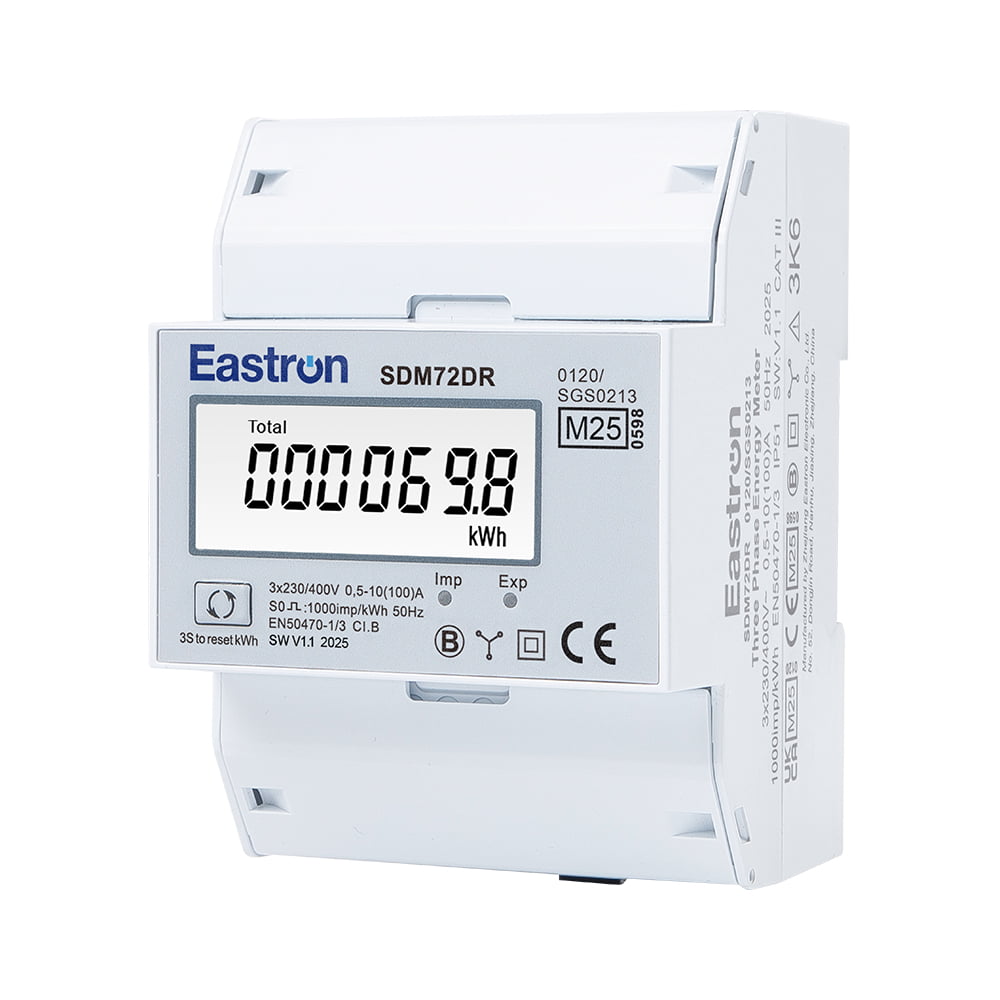
Product Consultation
Your email address will not be published. Required fields are marked *
Content
Imagine commissioning a rooftop solar array and then watching the export readout climb even though the site is supposed to run in zero-export mode. The inverter is configured correctly. The current transformer is the right size. The controller parameters look normal. The fault often comes down to one surprisingly small component: the meter.
A solar PV meter is not just a watt-hour meter with a solar label. It is the measurement component that tells the rest of the system whether energy is flowing from the array, into the building, or back to the grid. It has to detect direction, refresh quickly, communicate with a controller, and sit safely at the PV plant or the grid connection.
In short, if you want accurate generation reporting, feed-in tariff billing, or stable zero-export control, the PV meter matters as much as the inverter. Here is what it actually does, how it differs from a normal consumption meter, and how to choose one without expensive surprises.
A solar PV meter is an energy meter configured for the PV side of an electrical installation. Depending on where you install it, it can measure the energy produced by the PV array, the energy exported to the utility, the energy imported from the utility, or all three. Most modern PV meters do more than count kilowatt-hours: they also measure active power, voltage, current, frequency, and power factor, and they make those values available over Modbus, pulse, Wi-Fi, or other communication outputs.
Unlike a simple consumption meter, a PV meter is usually expected to record active energy in both directions. That is why so many PV meters have separate registers for import and export. Without that directional information, a zero-export controller has no way to know whether generated power is staying on site or spilling into the grid.
In a zero-export system, the meter is typically placed at the grid connection point. It sends import and export power values to a controller, which then adjusts the inverter output. In a feed-in tariff system, a second meter can be placed at the inverter output to verify how many kilowatt-hours the array actually generated.
If you want to see typical installation points before selecting hardware, Eastron's solar PV zero-export metering applications page gives a useful overview of where these meters are placed on both the AC and DC sides of a system.
The practical difference between a PV meter and a consumption meter comes down to measurement point and direction. A consumption meter is designed to measure the energy used by a load. It sits after the utility supply, often in distribution boards, and it usually needs to count energy in only one direction. A PV meter, by contrast, has to measure production, export, or import depending on where it is installed, and it must handle power flowing in both directions without losing accuracy.
| Feature | PV Meter | Consumption Meter |
|---|---|---|
| Measurement point | PV array output, inverter output, or grid connection | Consumer load or main building supply |
| Direction | Usually bidirectional for import and export | Often one-directional |
| Typical values | kWh generated, exported, and imported | kWh consumed |
| Communication | Modbus, pulse, Wi-Fi, or LoRa for controller integration | Pulse or Modbus for simple monitoring |
| Compliance | MID, UL, or PTB where billing applies | MID or utility approval |
Using a basic consumption meter as a PV meter can cause exactly the kind of failure installers see on site: the meter reports total energy flow but cannot tell the controller which direction it is flowing. In a net-metering setup, that can lead to overbilling, underbilling, or a controller that never stops hunting.
There is no single solar PV meter that fits every project. The right choice depends on the phase configuration, the maximum current, the required communication protocol, and the regulatory environment.
Residential systems often use single-phase PV meters, especially when the grid connection and the inverter output are both single-phase. Commercial installations and many modern three-phase inverters need a three-phase meter. If you measure a three-phase feed-in connection with a single-phase meter, you will miss the energy flowing on the other phases, and your export data will be wrong.
For a smaller system, a single-phase solar PV zero-export meter with 50 ms data update is a practical choice because it pairs fast response with Modbus communication for controller integration.
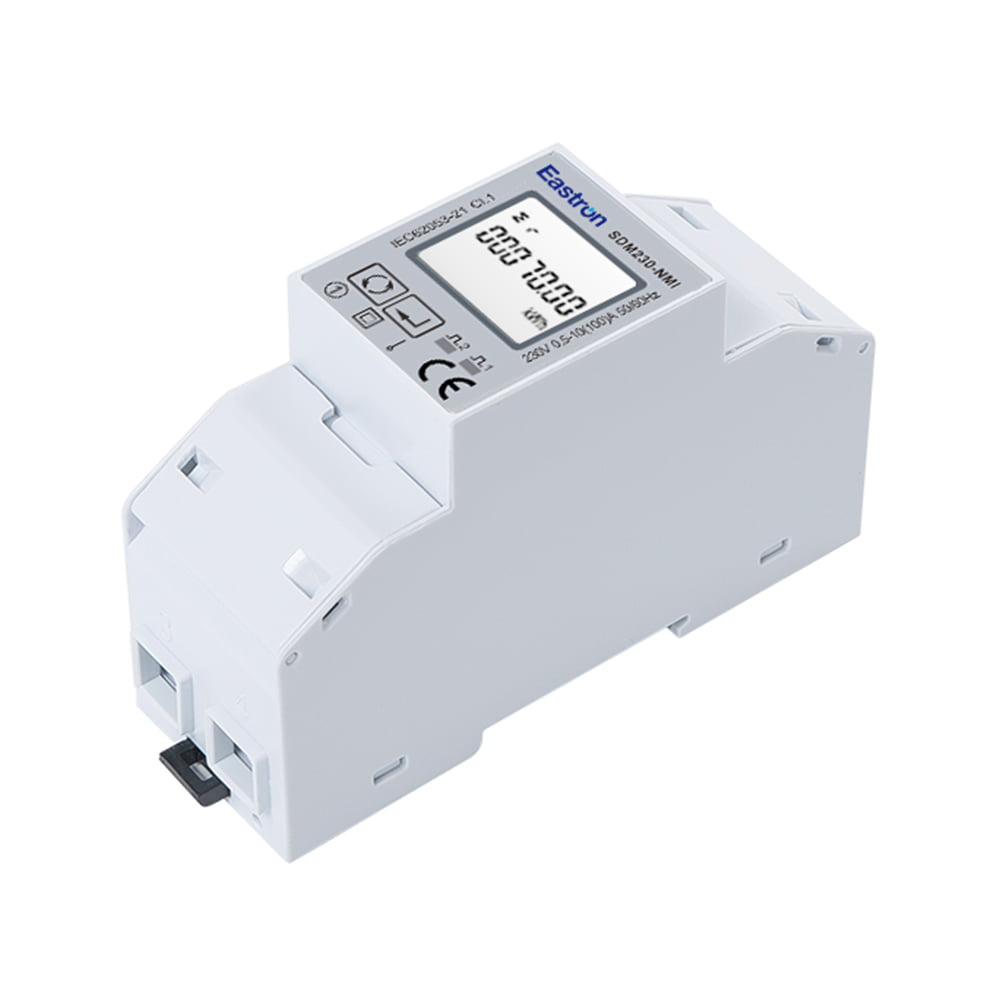 SDM230-NMI Din Rail Single Phase Multi-function Solar PV/Zero Export Meter with Eastron is China SDM230-NMI Din Rail Single Phase Multi-function Solar PV/Zero Export Meter with 50mS Data Update Manufacturers and Custo...View Product →
Direct-connected meters carry the full load current through the meter. They are common for loads or inverters up to 100 A and they do not need external current transformers. For larger systems, a CT-operated meter is safer and more flexible because the meter reads a reduced current from external CTs, usually 5 A or 1 A secondary, while the CTs are sized to the main conductor.
If you are metering a three-phase commercial array, a three-phase CT-connected solar PV meter for PV metering lets you match CT ratios to the actual installation current, which is more practical than running the full current through the meter on large circuits.
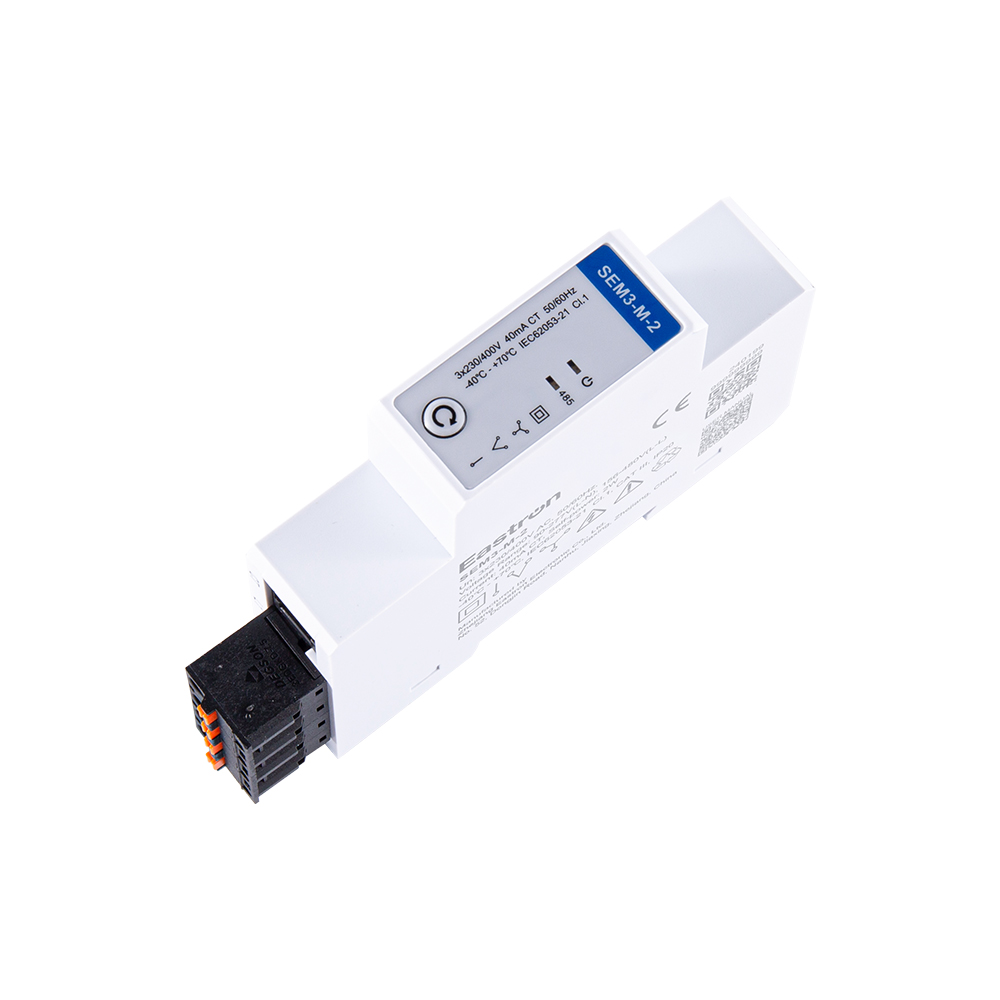 SEM3-M-2 RS485 CT Connection Three Phase Din Rail Energy Meter for PV Metering MEastron is China SEM3-M-2 RS485 CT Connection Three Phase Din Rail Energy Meter for PV Metering Manufacturers and Custom Suppliers, Facto...View Product →
A PV meter with only a pulse output can monitor generation, but it is not ideal for zero-export control because the controller must count pulses and calculate power, which adds latency. RS485 Modbus is the most common choice for controller integration because it provides direct power readings in watts and supports rapid polling. Wi-Fi and LoRaWAN are useful for remote monitoring, while Ethernet/Modbus TCP is common in data-center or larger commercial projects where speed and network integration matter.
Once you know the phase type, current range, and communication output, the next step is to check the specifications that determine whether the meter will work reliably in real operating conditions.
Most monitoring-grade meters are Class 1 or Class 0.5S. If the meter is used for feed-in tariff billing, choose a meter with a legal metrology approval. If your project requires a legal meter for the utility or subsidy program, a MID-approved three-phase CT-type solar PV meter gives you a combination of billing-grade compliance, CT flexibility, and Modbus output in one unit.
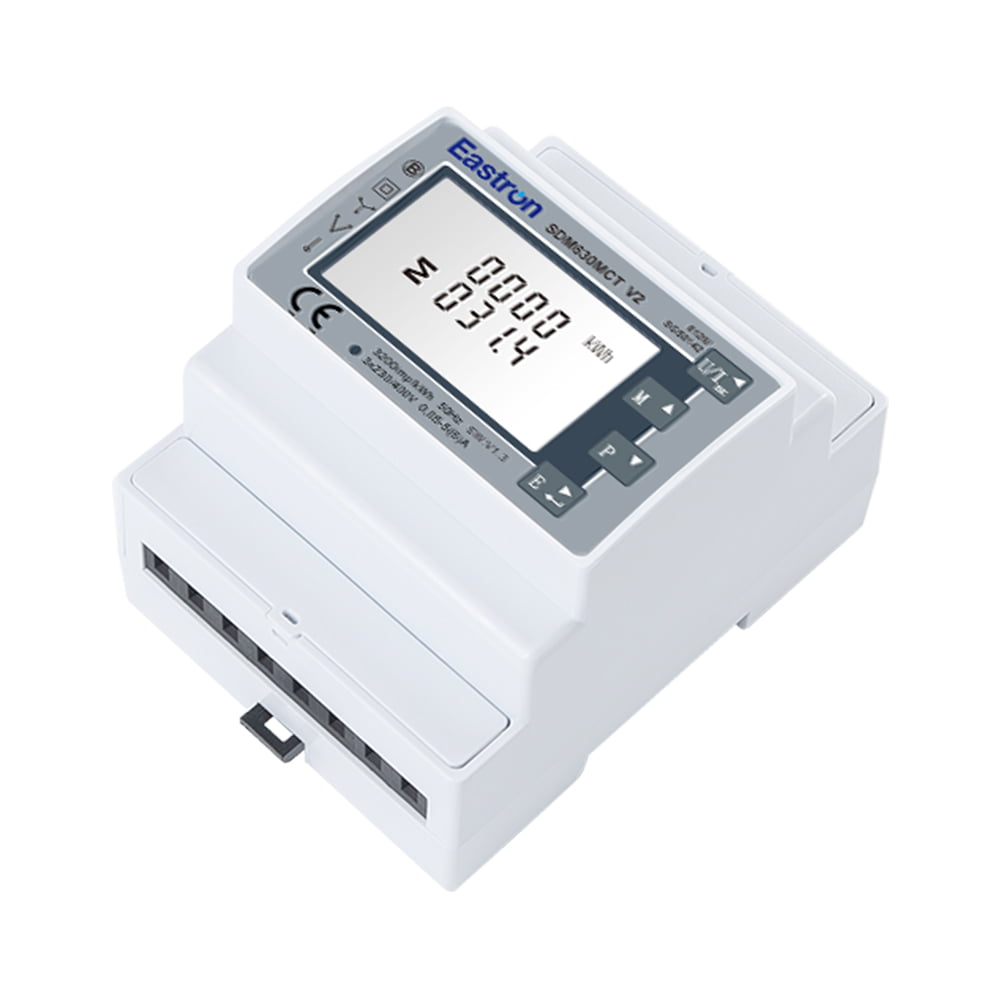 SDM630MCT V2 MID Approved CT Type Din Rail Three Phase Multi-function Solar PV Eastron is China SDM630MCT V2 MID Approved CT Type Din Rail Three Phase Multi-function Solar PV /Zero Export Meter for PV Metering Manuf...View Product →
Check that the meter has separate registers for imported and exported active energy. Some low-cost meters advertise bidirectional measurement but only record absolute energy, which means the generated and consumed energy cancel each other out. That makes billing and zero-export control impossible. Look for clear import/export register mapping in the Modbus protocol document before you buy.
Zero-export systems live and die by measurement speed. If the controller polls a meter that updates only once per second, the inverter may continue exporting for hundreds of watt-hours before it receives the command to reduce output. For modern zero-export and VPP applications, meters with a 50 ms data update are becoming the baseline because they give the controller time to react before the export event grows.
Check the meter width in DIN rail modules. A single-phase meter is often two or four modules wide, while a three-phase meter can be four, seven, or more modules wide, depending on whether it is CT-operated. Also confirm the auxiliary supply voltage range. Many PV meters are self-powered from the measured circuit, but some models with communication outputs may require a separate auxiliary supply to keep the communication active when the main supply is off.
Even a well-selected PV meter fails when installation details are wrong. These are the issues I see most often during commissioning:
A PV meter is not just a piece of hardware; it arrives with datasheets, user manuals, Modbus register maps, wiring diagrams, and certification documents. A supplier that keeps those documents current saves you hours of engineering time during integration. Eastron's engineering and manufacturing background is visible in its product structure: the company supports single-phase and three-phase meters, CT-operated models, Rogowski coil inputs, MID/UL/ETL variants, and the communication protocols that installers actually use on PV projects.
If you are still comparing different meters for a solar project, the differences in accuracy class, speed, and communication are more important than brand names. Start with the measurement point, then work through phase type, current range, communication, compliance, and update speed. If you need a more general reminder about meter selection, our guide to choosing the right energy meter covers the same trade-offs in a broader context.
The last piece of advice is simple: define whether the meter is for monitoring, billing, or zero-export control. That one decision determines almost every other specification. A correctly selected solar PV meter makes a solar project easier to commission, easier to bill, and far less likely to generate export surprises.
Your email address will not be published. Required fields are marked *

We develop and produce high performance electricity meters, power analyzers, current sensors, communication modules and management systems.
Address:NO. 52, Dongjin Road, Nanhu, Jiaxing, Zhejiang, China
Copyright @ Eastron Electronic Co., Ltd. All rights reserved
