

 English
 Español
 Deutsch
 中文简体
中文简体
Product Consultation
Your email address will not be published. Required fields are marked *
UL and ETL Listed Energy Meters: Safety Certification, Applications, and Buying Guide
Sep 21,2026
Smart Meter FAQ (Part 3) | Certification, Installation, and Procurement: Addressing 5 Practical Application Issues
Sep 20,2026
National Quality Month | A Look Inside Eastron Electronic: Quality Embedded in Every Stage
Sep 20,2026Content
An energy meter in an EV charging system does far more than count kilowatt-hours. It provides the verified consumption data that billing platforms rely on, gives network operators visibility into load distribution across multiple charge points, and in regulated markets, serves as the legal basis for charging customers for the energy they consume. Selecting the wrong meter — one with insufficient accuracy class, incompatible communication protocol, or a certification that does not match the local legal metrology requirements — creates problems that range from revenue loss and incorrect billing to regulatory non-compliance and costly retrofits after installation. With EV charging infrastructure being deployed at increasing scale across residential, commercial, and public settings, understanding the specific roles of AC and DC meters, MID certification, and Modbus communication is essential for anyone specifying, installing, or operating charging equipment.
The most fundamental distinction in meter selection is whether the charging station delivers AC or DC power to the vehicle. This is determined by the charger type, not by a preference — AC and DC meters are entirely different instruments that measure different electrical quantities and cannot be substituted for one another.
AC chargers — including all Mode 2 portable units and Mode 3 wallbox or pedestal chargers — deliver alternating current to the vehicle's onboard charger, which performs the AC-to-DC conversion internally. The energy meter in an AC charging installation measures the AC power consumed by the charger from the grid. AC meters for EV charging are typically single-phase (for up to 7.4 kW charging) or three-phase (for 11 kW and 22 kW charging) and must accurately measure voltage, current, power factor, and active energy in a waveform environment that may include harmonic distortion generated by the charger's power electronics. Accuracy class 1 (±1%) is the minimum acceptable for billing purposes in most markets, and class 0.5 (±0.5%) is preferred in high-throughput commercial installations where cumulative billing errors across many sessions become commercially significant.
DC fast chargers (CCS, CHAdeMO, GB/T) and ultra-fast chargers convert AC from the grid to DC internally and deliver direct current at voltages typically ranging from 200V to 1,000V DC, at currents up to 500A or more. The energy meter must be placed on the DC output side — between the charger power module and the vehicle connector — to measure the energy actually delivered to the vehicle. DC energy meters are a specialized product: they must handle wide voltage and current ranges, operate accurately across a broad range of charge rates (since EVs accept varying power levels throughout the charging session), and maintain measurement integrity despite the high-frequency ripple current that DC chargers inherently produce. Ripple rejection is a key specification — look for meters rated to IEC 62053-41, the standard specifically developed for DC energy measurement in EV charging applications. Accuracy class 0.5 or better is the norm for DC meters in commercial fast-charging stations.
MID stands for the European Measuring Instruments Directive (2014/32/EU), the EU framework that defines the legal metrology requirements for instruments used in commercial transactions — including energy meters used to bill EV drivers for electricity consumed. An energy meter bearing the MID mark has been type-approved by a notified body, confirming that it meets the accuracy, durability, and tamper-resistance requirements of the directive. The CE mark alone is not sufficient; only the specific MID conformity marking (the letter M followed by the last two digits of the year of marking, enclosed in a rectangle) confirms legal metrology compliance.
In practice, MID certification matters whenever an energy meter is used as the basis for a financial transaction between two parties — most commonly when a charging network operator bills an EV driver by the kWh. In many EU member states, using a non-MID meter for billing at a public charge point is illegal, and operators face enforcement action and liability for incorrect billing. For private workplace chargers where employees are reimbursed for home or workplace charging, the same legal requirement typically applies if the reimbursement is per-kWh rather than a flat rate.
MID certification for DC meters is more recent and was enabled by the adoption of EN 50631-1 and the subsequent inclusion of DC electricity meters in the MID framework. When specifying a DC meter for a fast-charging station that will bill by the kWh, confirm explicitly that the meter holds MID approval for DC measurement — not just a general MID certificate that covers only AC measurement modes. Outside the EU, equivalent legal metrology frameworks apply: OIML R 46 internationally, Weights and Measures Act certification in the UK post-Brexit, and state-level certification requirements in the United States under NIST Handbook 44.
Modbus is a serial communication protocol originally developed by Modicon in 1979 that has become the de facto standard for industrial device communication. In EV charging installations, Modbus RTU (over RS-485 wiring) and Modbus TCP (over Ethernet) allow the energy meter to transmit real-time measurement data — voltage, current, active power, reactive power, power factor, frequency, and cumulative energy — to a charge point controller (CPC), energy management system (EMS), or building management system (BMS).
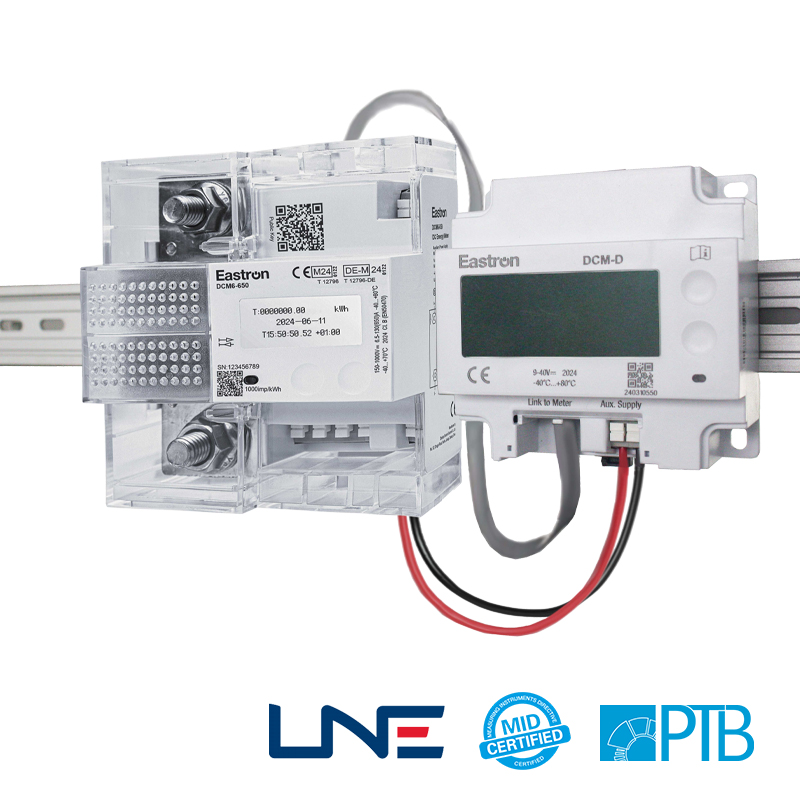
Modbus RTU transmits data as binary frames over a two-wire or three-wire RS-485 bus. Up to 32 devices (or more with repeaters) can share a single RS-485 bus, each assigned a unique device address (1–247). This makes Modbus RTU highly cost-effective in installations with multiple meters — such as a multi-bay charging hub where each bay has its own meter — since all meters share a single cable run back to the controller. RS-485 supports cable runs of up to 1,200 meters at standard baud rates (typically 9,600 or 19,200 bps for energy meters), making it suitable for distributed charging installations across large car parks or industrial sites. The key configuration parameters — baud rate, parity, stop bits, and device address — must match between the meter and the controller, and are usually set via DIP switches or the meter's front-panel menu.
Modbus TCP encapsulates Modbus frames within standard TCP/IP packets, allowing meters to communicate over existing Ethernet infrastructure, including Wi-Fi and fiber networks. Each meter has its own IP address and is polled directly by the management system without the addressing constraints of an RS-485 bus. Modbus TCP is preferred in installations where Ethernet infrastructure is already present, where high polling rates are required for real-time load management, or where integration with cloud-based OCPP (Open Charge Point Protocol) backends is needed. Many smart energy meters now offer both RS-485 and Ethernet ports simultaneously, providing installation flexibility.
With the fundamental parameters understood, the following table provides a side-by-side comparison of the specifications that matter most when evaluating meters for different EV charging applications:
| Specification | AC Meter (Mode 3) | DC Meter (Fast Charger) |
| Applicable Standard | IEC 62053-21 / IEC 62053-22 | IEC 62053-41 |
| Accuracy Class | Class 1 minimum; Class 0.5 preferred | Class 0.5 standard |
| MID Certification | Required for public billing (EU) | Required; confirm DC-specific MID approval |
| Voltage Range | 230V / 400V AC (1-ph or 3-ph) | Up to 1,000V DC |
| Current Range | Up to 100A direct; CT-connected above | Up to 500A or higher via shunt |
| Communication | Modbus RTU / Modbus TCP / pulse output | Modbus RTU / Modbus TCP / CAN bus |
| Installation Location | Inside charger enclosure or DIN rail panel | DC output side, inside charger cabinet |
Before finalizing a meter specification for any EV charging installation, work through the following checklist to confirm that all critical requirements are addressed:
Investing time in meter selection at the design stage is far less costly than discovering a compliance gap after installation. A correctly specified energy meter will provide accurate, legally defensible billing data, seamless integration with the charging management platform, and a service life that matches the expected 10–15 year operational horizon of the charging infrastructure it supports.
Your email address will not be published. Required fields are marked *

We develop and produce high performance electricity meters, power analyzers, current sensors, communication modules and management systems.
Address:NO. 52, Dongjin Road, Nanhu, Jiaxing, Zhejiang, China
Copyright @ Eastron Electronic Co., Ltd. All rights reserved
