

 English
 Español
 Deutsch
 中文简体
中文简体
Product Consultation
Your email address will not be published. Required fields are marked *
Content
Walk into a distribution board built fifteen years ago and you will probably find a row of analog ammeters with a single pointer and no communication port. The panel shows that current is flowing, but not how much energy was consumed since Monday, what the power factor did at midday, or which phase is drifting out of balance. A smart panel meter closes that gap in a single panel cutout: it measures the electrical parameters, displays them clearly, and pushes the data to a PLC, a SCADA system, or an energy management platform over a standard communication bus.
The short version is this: a smart panel meter is a multifunction, panel-installed measuring instrument with communication built in. It is the practical upgrade when you need more than a live reading and do not want to install a full power analyzer on every feeder. If that describes your project, the rest of this guide walks through exactly what to look for.
The term is used loosely, so it helps to define the boundaries. A conventional analog panel meter displays one value, usually current or voltage, with an accuracy that is hard to defend in an energy audit. A basic digital panel meter improves readability and may add a pulse output, but it still only tells you what is happening at that instant. A smart panel meter goes several steps further.
| Feature | Analog panel meter | Basic digital panel meter | Smart panel meter |
|---|---|---|---|
| Display | Moving needle | Simple digital readout | Multiline display with backlight |
| Measured variables | One (current or voltage) | One to a few | Voltage, current, power, energy, power factor, frequency, harmonics |
| Communication | None | Optional pulse output | RS485 Modbus, M-Bus, Ethernet, Wi-Fi, LoRaWAN |
| Data logging | None | None | Demand and energy registers |
| Configurable CT ratio | No | Limited | Yes |
| Typical accuracy | Class 1.5 to 2.5 | Class 1 | Class 0.5 to 1 |
Accuracy matters more than most buyers expect once the numbers leave the panel. A Class 1 meter reading on a 630 A feeder can drift far enough from reality that sub-billing becomes contentious, while a Class 0.5S device used with correctly sized CTs keeps the figures defensible. In legal metrology applications, from tenant billing to EV charge point settlements, the meter needs a recognized approval such as MID certification, not just a good specification sheet.
Most panel-mounted smart meters continuously calculate more than a dozen values. The core set matches what you expect from a high-end multifunction meter: per-phase and total active power, reactive power, apparent power, power factor, frequency, and imported and exported active energy. Better instruments add partial energy registers, maximum demand, and harmonic readings that help you see the quality of the supply, not only the quantity.
Choosing a smart panel meter comes down to four decisions: how accurate it must be, how it will be connected to the circuit, how it will communicate, and how it will fit the panel. Each decision narrows the field quickly.
Start with the use case rather than the datasheet. For internal energy management, a Class 1 meter is usually adequate. For sub-billing, feed-in tariffs, or charging applications, specify Class 0.5S in the measurement path and choose a variant with MID approval. If the panel is destined for North America, UL/ETL-listed series avoid problems at inspection. When harmonic content is part of the monitoring requirement, a panel-mounted multifunction power analyzer with RS485 Modbus provides the same cutout size with deeper power-quality pages. Just remember that certification applies to the exact model, not the whole family; confirm the approval mark before you order.
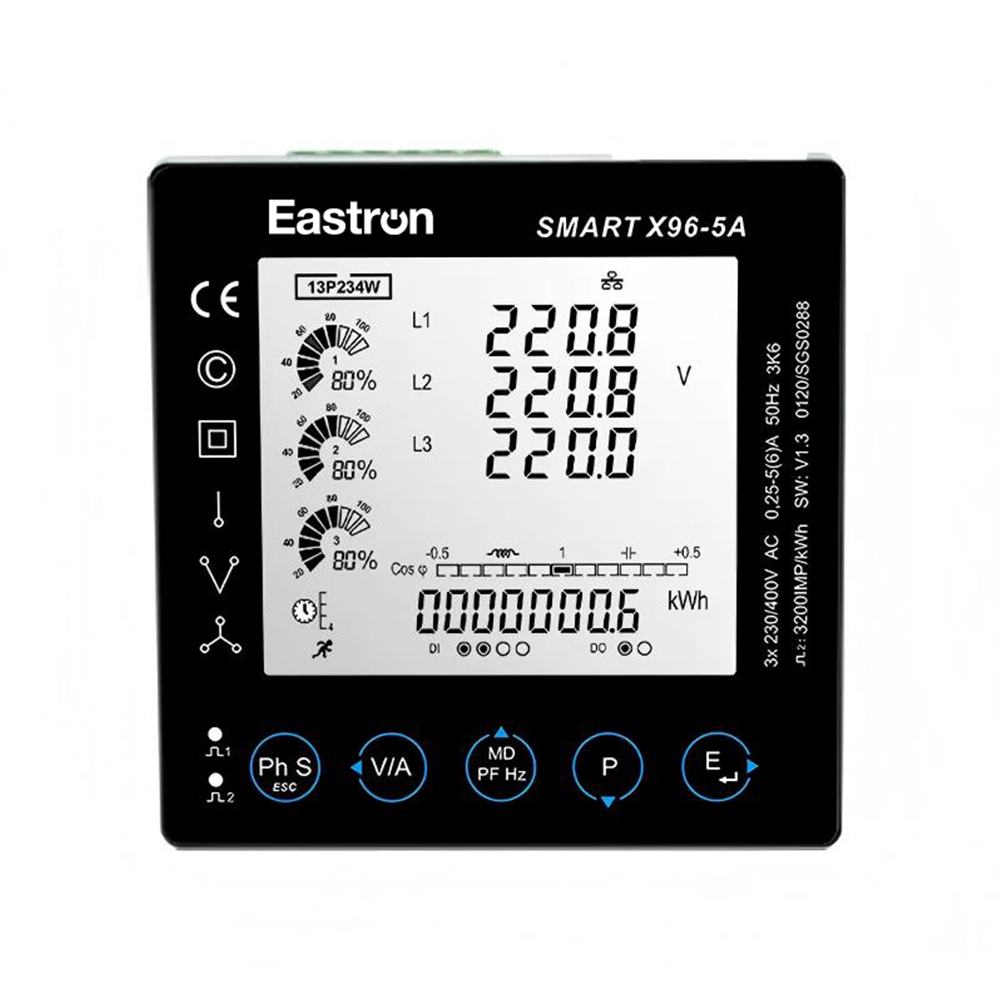 Smart X96-5A RS485 Modbus Panel Mounted Multi-function Power Analyzer ManufacturEastron is China Smart X96-5A RS485 Modbus Panel Mounted Multi-function Power Analyzer Manufacturers and Custom Suppliers, Factory,Eastro...View Product →
Direct-connected meters handle up to roughly 100 A and are the simplest to install. Above that, the meter reads from external sensors: conventional 5 A CTs, three-in-one current sensors, or flexible Rogowski coils. That choice changes your bill of materials and your installation labor, so make it before quoting the job. Meter accuracy guarantees mean nothing without correctly sized CTs. A 600:5 CT on a 200 A circuit is fine, but a 2000:5 CT on a 50 A load operates near the bottom of its range and produces readings you cannot trust.
This is where smart is actually defined. RS485 Modbus RTU remains the default for industrial panels and plays well with PLCs and most energy management software. Ethernet Modbus TCP is the natural choice for IP-based networks in data centers and larger facilities. Wi-Fi and LoRaWAN variants reduce cabling in retrofit projects, and M-Bus appears wherever utility conventions demand it. Check the digital inputs and outputs as well: a pulse output for utility metering, a digital input for breaker status, and a relay output for alarms or load control can save you from adding separate components later.
Panel-mounted instruments come in standard 72x72 mm and 96x96 mm cutouts. If the board already has punch-outs, match them; if you are designing new, 96x96 offers a roomier display and usually more information per page. DIN rail meters remain a legitimate alternative when the front of the panel is crowded, but the term panel meter implies a front-of-board instrument, so confirm the cutout dimension before ordering.
Data center power chains are dense, and capacity planning depends on meters that report into a DCIM or Modbus TCP network without a custom gateway on every feeder. A networked panel meter on each distribution column gives operators a live view of load per feed, and harmonic readings help flag the effects of modern server power supplies. The Ethernet Modbus TCP panel meter from our panel board range is typically specified for exactly this role: it fits a standard panel cutout, connects straight to the IP network, and reports energy and power data to the central system.
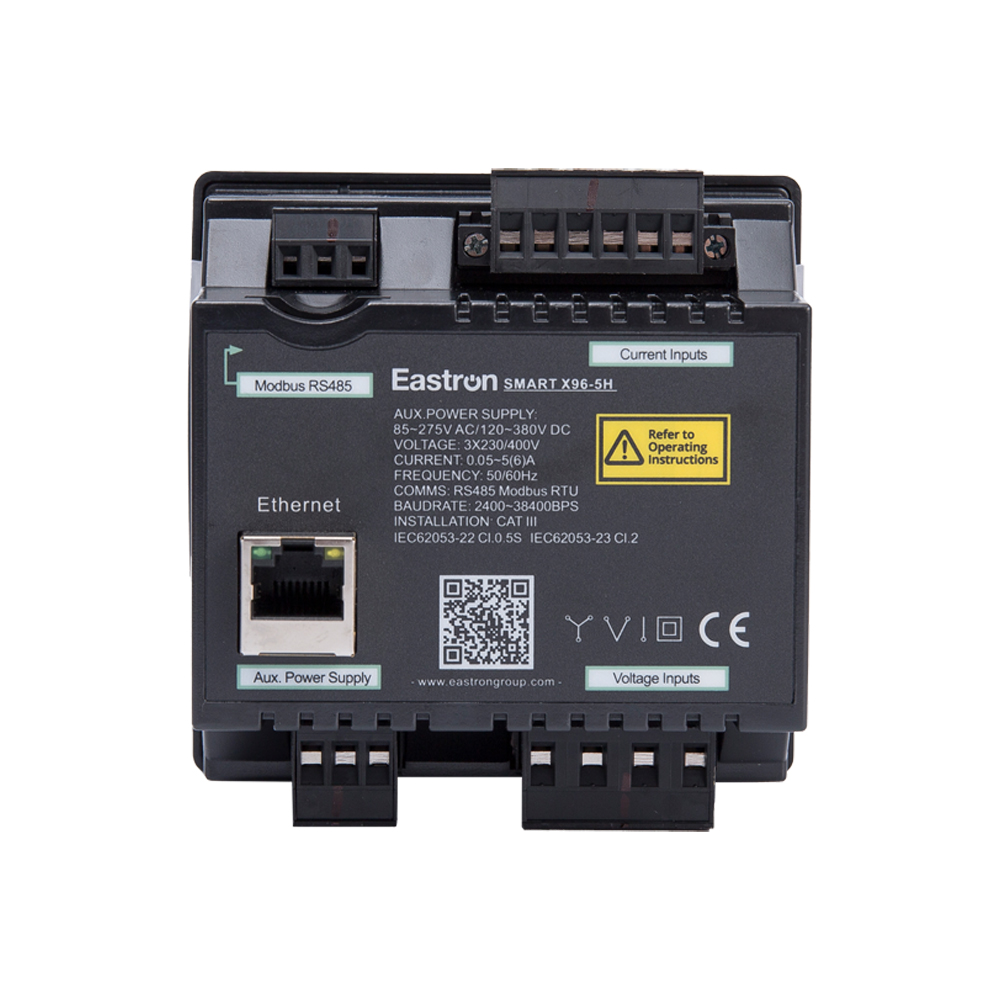 Smart X96-5H Ethernet Modbus TCP Three Phase Panel Mounted Panel Meter for ElectEastron is China Smart X96-5H Ethernet Modbus TCP Three Phase Panel Mounted Panel Meter for Electricity Distribution Manufacturers and Cu...View Product →
Charging infrastructure and PV systems add two things that older instruments cannot deliver: bidirectional energy measurement and traceability. A meter that records imported and exported energy is essential for zero-export control and feed-in schemes, while DC charge points need DC-rated meters with the correct shunt connection. Choose a billing-prepared variant from the start, and you avoid a second installation when the site moves to formal cost allocation.
For switchboard builders, the case is simple. One instrument on the incomer replaces a collection of discrete meters and gives the customer a professional, readable summary of the whole installation. In multi-tenant buildings, the same device supports sub-billing if it carries the right approval. When the meter must stand up to a property owner's audit, a MID-certified panel-mounted multifunction panel meter keeps the billing path defensible.
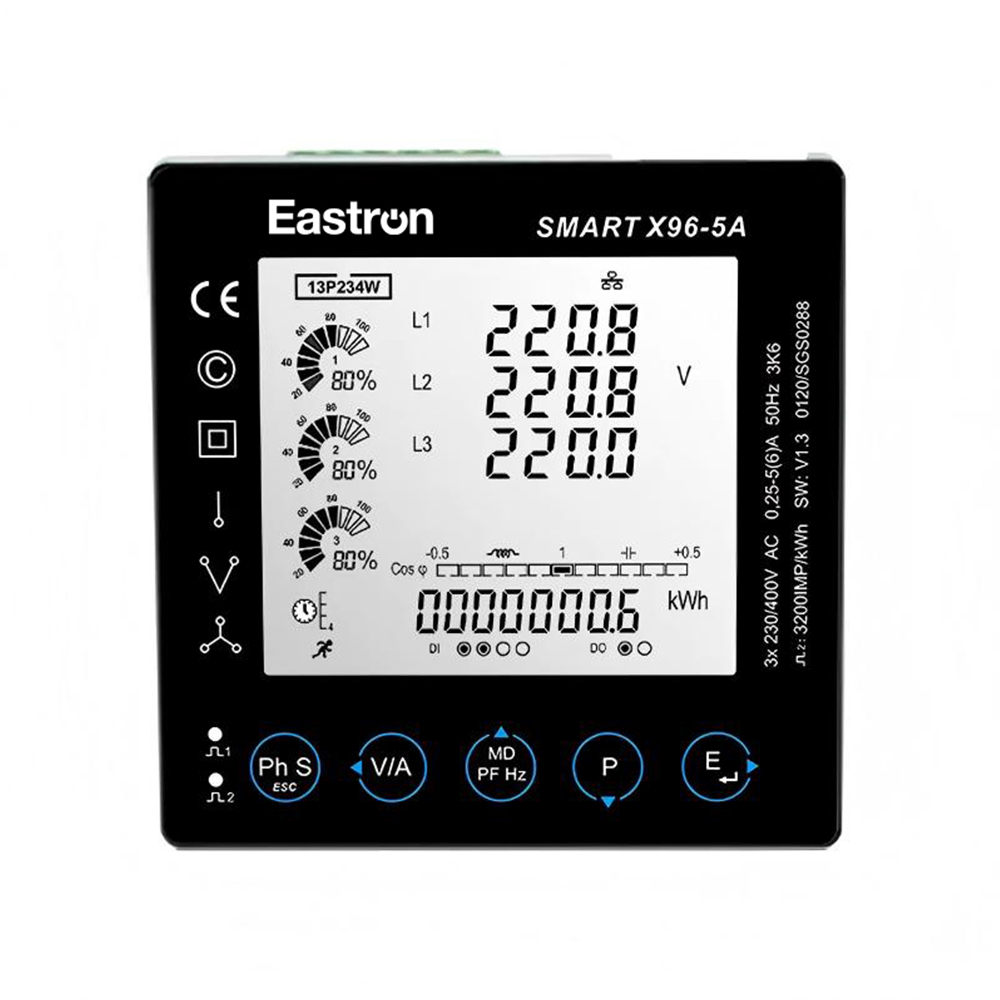 Smart X96-5A MID Three Phase Panel Mounted Multi-function Panel Meter for ElectrEastron is China Smart X96-5A MID Three Phase Panel Mounted Multi-function Panel Meter for Electricity Distribution Manufacturers and Cus...View Product →
After years of helping customers work through panel projects, a handful of mistakes come up again and again. Any one of them can turn a simple meter purchase into a field modification.
Panel meters are long-life products; you may be ordering the same model for ten years, so documentation and version control matter more than the initial price difference. Eastron publishes datasheets and user manuals for each series and keeps protocol documents under version control, with engineering input from teams in China and the United Kingdom. When your commissioning engineer asks which register holds total import energy, an answer backed by the latest manual saves hours of guessing. For context on how the company builds and supports these instruments, the engineering and manufacturing background of Eastron's metering range is a good place to start, and our separate guide on choosing the right energy meter for your load profile covers the wider single-phase and three-phase side of the same decision.
The selection process itself is straightforward once the priorities are clear: confirm the accuracy class the application requires, size the current transformers correctly, verify the communication bus, and check the panel cutout before ordering. Do that, and the meter will quietly deliver reliable data for the next fifteen years, which is more than the old analog panel ever could.
Your email address will not be published. Required fields are marked *

We develop and produce high performance electricity meters, power analyzers, current sensors, communication modules and management systems.
Address:NO. 52, Dongjin Road, Nanhu, Jiaxing, Zhejiang, China
Copyright @ Eastron Electronic Co., Ltd. All rights reserved
