

 English
 Español
 Deutsch
 中文简体
中文简体
Product Consultation
Your email address will not be published. Required fields are marked *
3 Phase CT Meter Guide: How to Choose, Install and Wire CT-Operated Meters
Sep 28,2026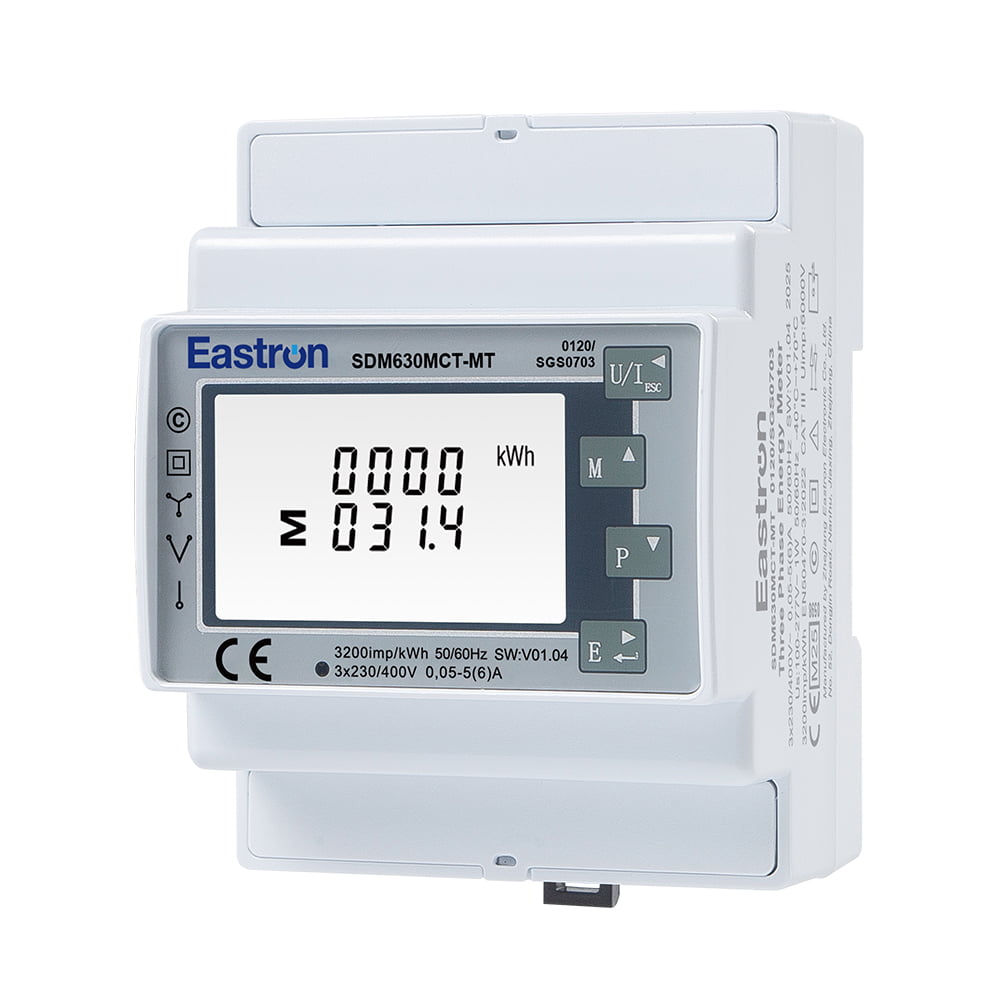
UL and ETL Listed Energy Meters: Safety Certification, Applications, and Buying Guide
Sep 21,2026
Smart Meter FAQ (Part 3) | Certification, Installation, and Procurement: Addressing 5 Practical Application Issues
Sep 20,2026Content
A 3 phase CT meter measures electrical energy on a three-phase supply without carrying the full load current through its own terminals. Instead, three current transformers step the phase currents down to a small, standardised signal — typically 5 A, 1 A, or a millivolt output — and the meter converts that signal back into kilowatt hours, power, voltage, current and power factor readings. For anyone specifying metering on a commercial, industrial or renewable energy site, this arrangement is often the only practical way to measure accurately at the currents involved.
CT-operated metering is not simply a scaled-up version of a direct-connected meter. The choice affects accuracy class, wiring practice, cabinet space, approval requirements and the long-term cost of the installation. Getting those details right at the design stage saves a great deal of rework on site.
Three-phase systems deliver power across three conductors, usually with a neutral, so the meter has to sample three voltages and three currents and calculate the relationships between them. When CTs are used, the meter never sees the primary current directly. It sees the secondary signal, and the transformer ratio tells it how to scale the result.
A CT is a magnetic device that sits around a conductor. The conductor itself acts as the primary winding, while the secondary winding produces a current proportional to what flows through the ring. A 300/5 A CT, for example, delivers 5 A on the secondary when 300 A flows in the primary. Solid-core CTs are threaded over the cable before termination, while split-core and Rogowski coil designs can be fitted around existing conductors without disconnection, which is useful in retrofit projects where downtime is expensive.
Modern three-phase CT meters do far more than accumulate kWh. A typical measurement set includes active, reactive and apparent energy in both directions, per-phase voltage and current, active and reactive power, power factor and frequency, and often total harmonic distortion. Bidirectional registers matter where generation and consumption share a connection, and multi-tariff registers support time-of-use billing. Fast update rates, in some designs as short as 50 ms, are needed for export limitation and demand response control.
The first decision in any three-phase metering project is whether the load can be measured directly or must be measured through transformers. Direct-connected meters pass the full current through internal shunts and are compact and simple, but their current rating caps the application. CT-operated meters remove that ceiling at the cost of additional components and wiring discipline.
| Aspect | Direct-Connected Meter | CT-Operated Meter |
|---|---|---|
| Maximum current | Limited by meter rating, commonly 45 A to 100 A per phase | Set by the CT primary rating, from tens to several thousand amperes |
| Installation | Load cable terminates in the meter | Conductors pass through CTs; meter sits on the secondary side |
| Cabinet space | Minimal | Space needed for three CTs plus secondary wiring |
| Accuracy at high current | Falls outside the rated range | Maintained across a wide primary range |
| Retrofit difficulty | Supply must be disconnected | Split-core and Rogowski options allow fitting without breaking the circuit |
| Typical use | Small commercial units, sub-metering, individual machines | Main incomers, industrial plants, EV charging, PV and data centre distribution |
In practice, the boundary sits somewhere around 100 A per phase. Below it, a direct meter is usually cheaper and faster to install. Above it, or wherever cable size makes termination impractical, CTs take over. Where a project needs both billing-grade accuracy and per-phase diagnostics on a large supply, CT-operated metering is effectively the default choice.
Match the CT primary to the actual maximum load current, not simply to the rating of the upstream breaker. A heavily oversized CT pushes the meter to the bottom of its measuring range and hurts accuracy at low load. Secondary output must match as well: 5 A CTs suit short cable runs and conventional meters, 1 A CTs reduce burden over long distances, and millivolt or Rogowski coil outputs require a meter or integrator designed for that signal. Polarity matters too, because a reversed CT produces negative power readings on that phase.
Accuracy class defines the maximum error permitted across a specified current range. Class 1 suits monitoring and internal cost allocation, while Class 0.5S and Class 0.2S are normal where money changes hands or where regulations apply. In the European Union, MID approval is the recognised route to billing-grade metering, while North American projects typically look for UL or ETL listing. German EV charging projects add PTB and Eichrecht requirements on top. Always confirm that the certificate covers the specific model and configuration, because a series name alone is not enough.
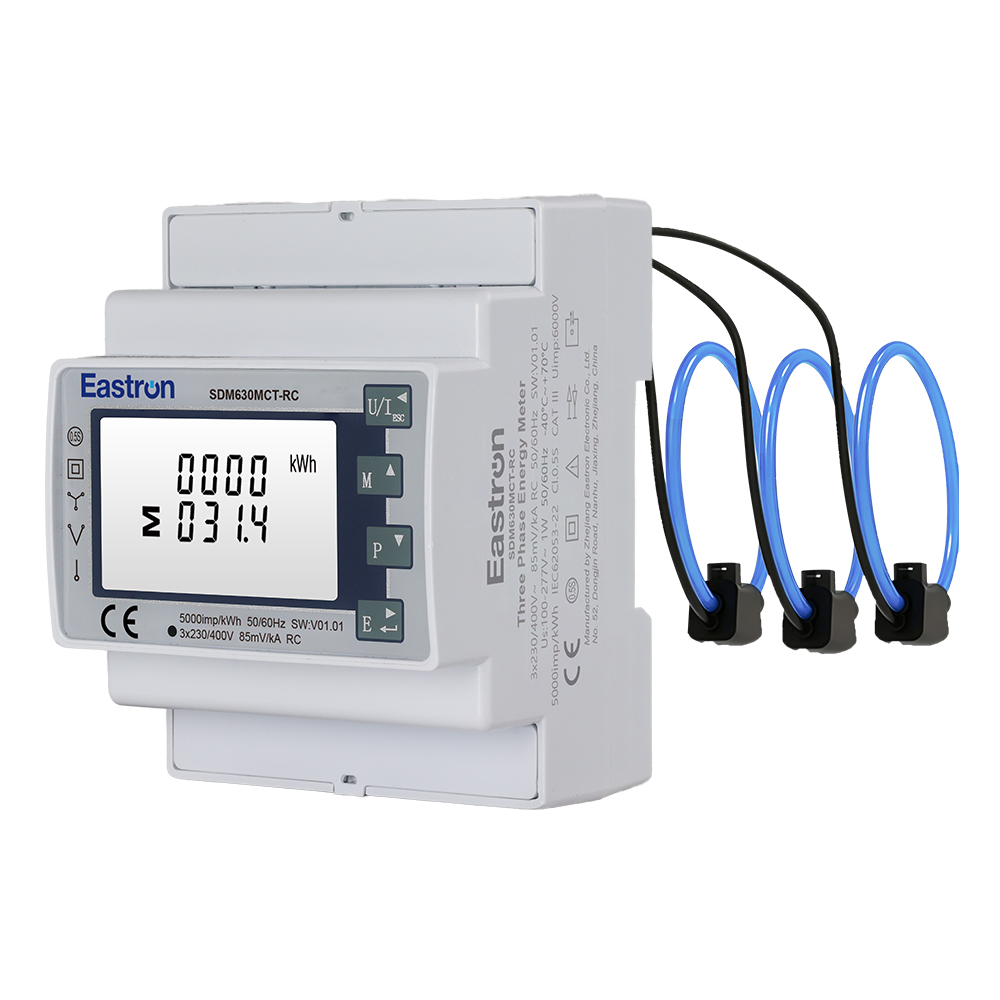
 RS485 Modbus CT operated Din Rail Three Phase MID Energy MeterWork with 3P4W/3P3W/1P2WView Product →
The communication interface decides how the meter fits into the wider system. RS485 with Modbus RTU remains the workhorse for building management and industrial control, while M-Bus and DLT645 appear in utility and district metering. Ethernet and Modbus TCP suit data centre and PDU-level monitoring, and Wi-Fi or LoRaWAN help where cabling is impractical. Digital inputs, relay outputs and multi-tariff registers extend the meter into load control and prepayment roles.
Most three-phase CT metering problems trace back to a small number of installation errors that are easy to prevent with a methodical commissioning routine.
A short verification pass — polarity, ratio, phase sequence, and a comparison of per-phase readings against a known load — catches nearly all of these before the system goes live.
CT-operated metering appears wherever the load is large, the cable is thick, or measurement points are distributed across a site.
Eastron Electronic is a manufacturer of electricity products and energy measurement solutions based in Jiaxing, China, with additional engineering resources in the United Kingdom. The company's product range covers three-phase DIN rail and panel-mounted meters in direct and CT-operated versions, together with the current transformers, Rogowski coils and integrators that feed them, and the gateways that carry their data into management platforms.
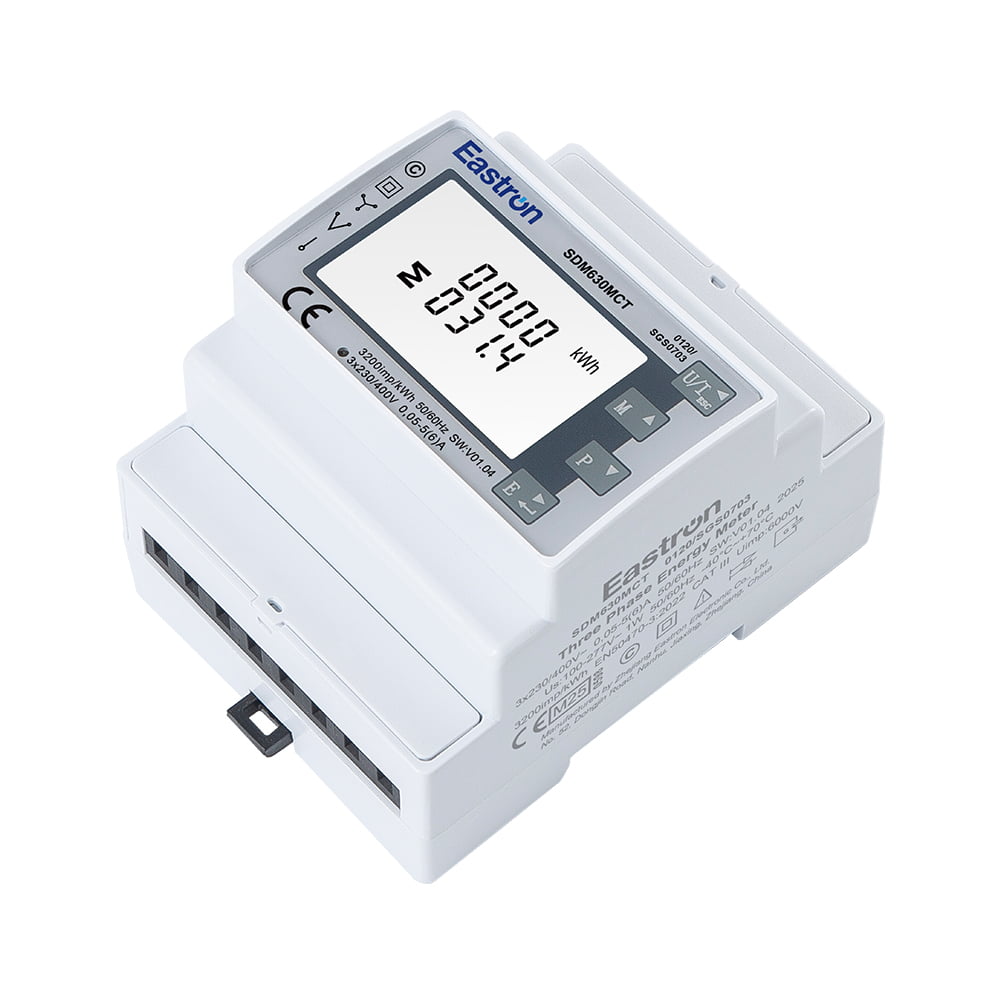
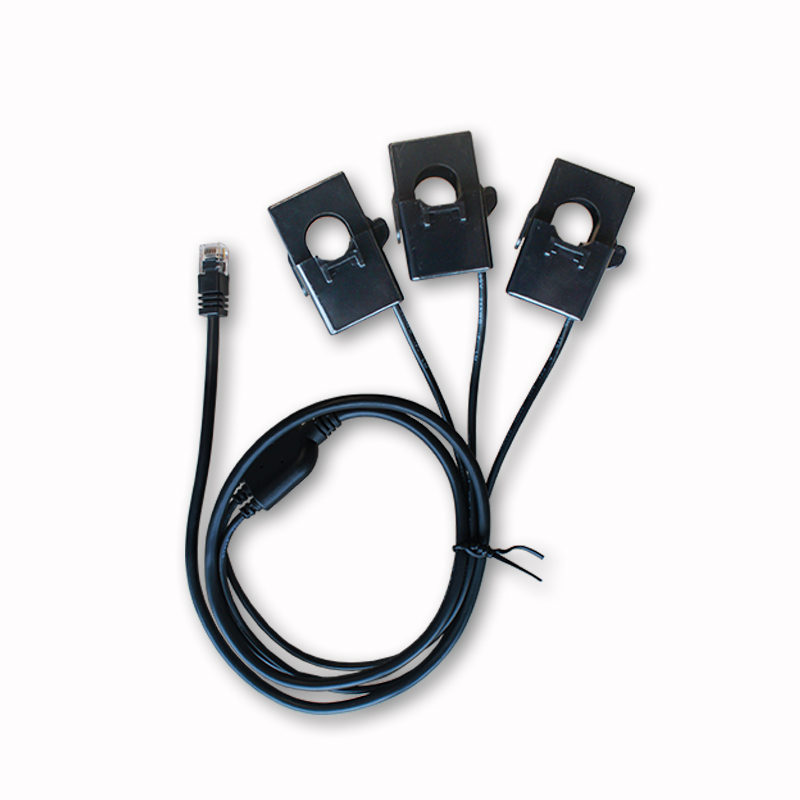 CT Type Three Phase RS485 Modbus Multi-function Energy MeterMulti-parameter measurementsView Product →
For project teams, that breadth matters. A single supplier for meter, sensor and communication equipment simplifies compatibility questions and reduces the number of different configuration tools a commissioning engineer has to learn. Technical documentation, including data sheets, user manuals and protocol files, is available through the download centre, and background on the company's engineering and quality approach can be found on the about page.
Work through these points before ordering hardware, and most specification errors disappear.
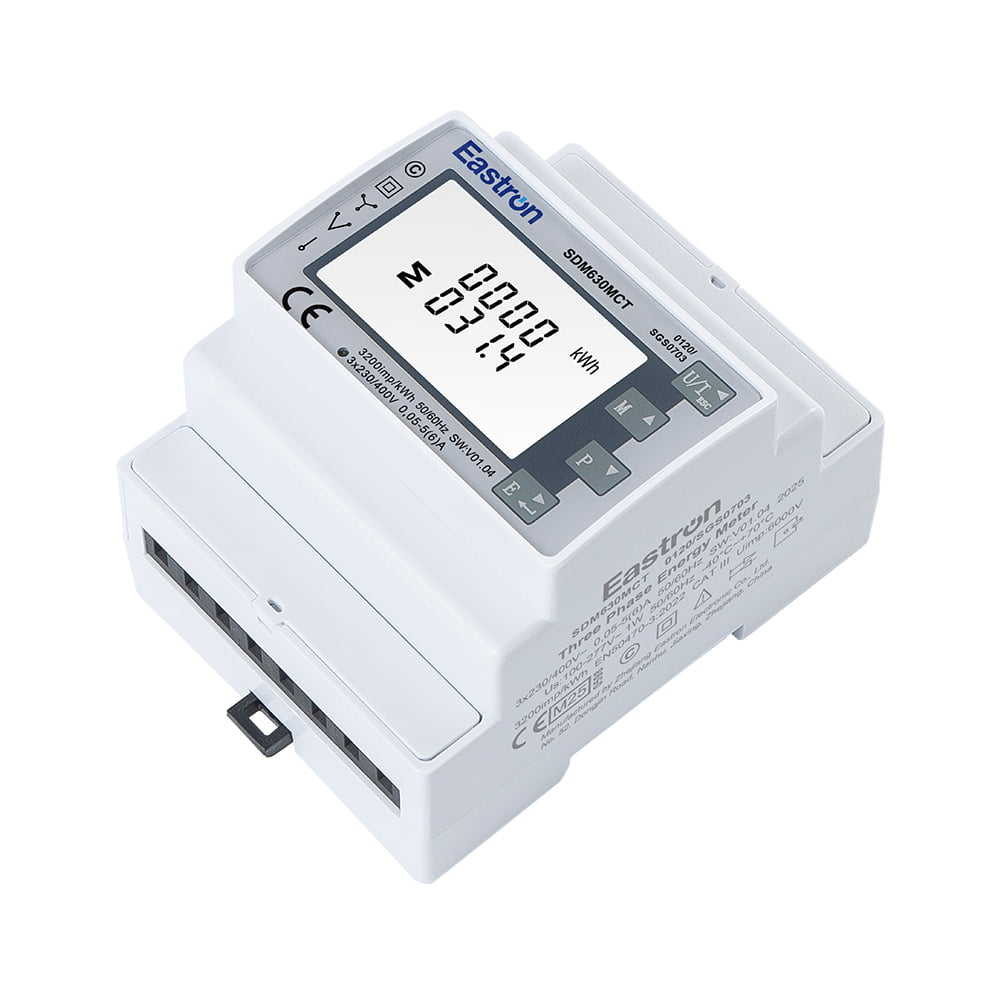 CT Operated RS485 Modbus Din Rail Three Phase UL Energy MeterWork with 1P2W/1P3W/3P4W/3P3WView Product →
Specifiers working to North American requirements, for instance, often need a CT-operated three-phase meter with UL listing and Modbus communication in the same package.
Yes, provided each load group has its own set of CTs and the meter supports multiple measurement channels or the installation uses separate meters on a shared communication bus. Multi-circuit metering is common in data centres and tenant billing.
Every current and power reading scales by the same error factor, so the energy totals will be wrong even if the meter itself is accurate. The ratio must be programmed to match the installed transformers.
Most three-phase DIN rail meters are self-powered from the measured voltage, so no auxiliary supply is required for basic measurement. Communication modules and display options may have their own requirements, which should be checked against the data sheet.
A three-phase CT meter is a small component in a large installation, but it sits at the point where energy data becomes commercially and operationally meaningful. Choosing the right CT ratio, accuracy class, approval and communication interface at the design stage keeps that data trustworthy for years, and keeps the metering cabinet simple to maintain long after commissioning.
Your email address will not be published. Required fields are marked *

We develop and produce high performance electricity meters, power analyzers, current sensors, communication modules and management systems.
Address:NO. 52, Dongjin Road, Nanhu, Jiaxing, Zhejiang, China
Copyright @ Eastron Electronic Co., Ltd. All rights reserved
