

 English
 Español
 Deutsch
 中文简体


Product Consultation
Your email address will not be published. Required fields are marked *
Content
A three phase WiFi energy meter does the same electrical job as any other three-phase meter — it measures voltage, current, power and energy across all three phases — but it reports what it measures over a wireless network instead of a cable. That single design choice changes where the meter can live, how quickly data reaches a dashboard, and how much labour the installation costs. It also changes the questions worth asking before you buy.
We manufacture these meters and spend a great deal of time talking to installers, panel builders and system integrators about them. The short version: a three-phase Wi-Fi meter is excellent when you need live data in a building that already has wireless coverage, and it is the wrong tool when the meter sits inside a sealed metal enclosure next to a substation. Everything else is detail — but it is detail worth getting right the first time.
A good three-phase meter is not just a totaliser. Modern units log per-phase voltage and current, total and per-phase active, reactive and apparent power, power factor, frequency and, on more advanced models, total harmonic distortion. They keep separate registers for imported and exported energy, which starts to matter the moment there is a solar inverter or a battery system on site.
Sampling behaviour is the part buyers overlook most often. A meter that refreshes its measured values once a second is perfectly adequate for monthly reporting but far too slow for zero-export control, where the inverter has to react to a changing load within a few cycles. Some three-phase meters in our range publish new values every 50 ms for exactly that reason.
The wireless side usually plays two roles: joining an existing network as a client, or broadcasting its own access point so a technician can set the device up and read it on the spot. Many designs also expose a Modbus TCP register map over the wireless link, which means the software already reading an Ethernet meter can read a Wi-Fi one without modification.
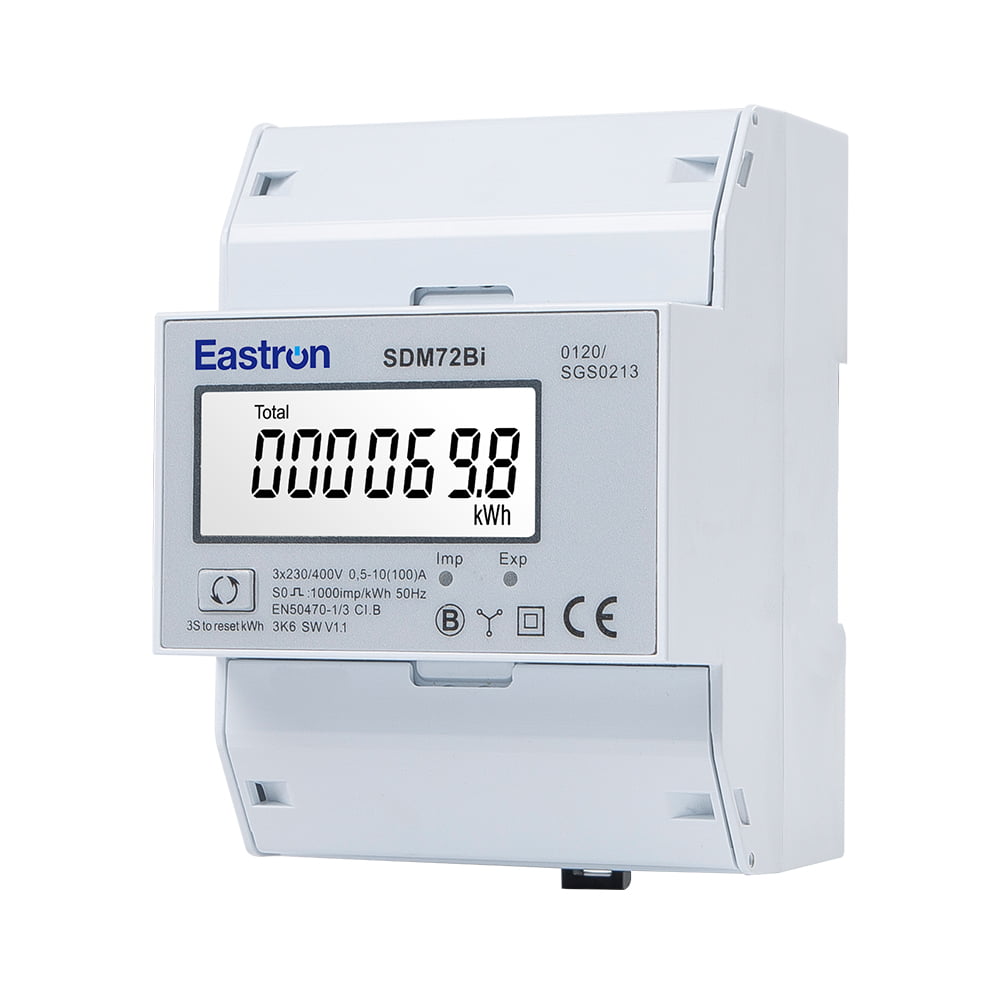
 SDM630-WIFI Three-Phase Wi-Fi Energy MeterWi-Fi three-phase energy meter for IoT monitoring, with 100A direct connection, multi-parameter measurement, and MID certification for remote centralized management.View Product →
There is no universally best data path, only one that fits the building. RS485 remains the workhorse for large meter banks because it is deterministic and cheap per device, but it needs a daisy-chained twisted pair and someone to terminate it properly. Ethernet is superb inside cabinets and data halls where switches and patch panels already exist. LoRaWAN wins on distance and power. Wi-Fi wins when the cable run is the expensive part.
That last point is not trivial. Retrofitting a metering point in a finished commercial building often means pulling cable through occupied space, and the labour can cost several times the price of the instrument. If reliable 2.4 GHz coverage already reaches the point where the meter will be installed, a wireless meter removes that cost entirely.
| Path | Cabling needed | Typical refresh | Best suited to | Main limitation |
|---|---|---|---|---|
| Wi-Fi 2.4 GHz | None beyond supply | 1-60 s, faster on some models | Retrofit, single meters, small clusters | Steel and concrete weaken signal |
| RS485 Modbus RTU | Twisted pair daisy chain | Sub-second polling | Large meter banks, industrial panels | Wiring, termination, addressing |
| Ethernet Modbus TCP | Cat5e or Cat6 to a switch | Sub-second | Cabinets, data centres, substations | Port availability, cable cost |
| LoRaWAN | None | Minutes | Remote sites, long range, low power | Low bandwidth, gateway required |
| M-Bus | Two-wire bus | Minutes | Utility and district metering | Needs a bus master |
This decision comes before the communication question, because it determines the physical size of the meter and the safety of the installation. Direct-connected three-phase meters take the load current through their own terminals, usually up to around 100 A per phase, and they are the simplest option for new distribution boards and modest loads.
Current transformer operated meters are the answer everywhere else. If the circuit is rated well above the direct rating, if the conductors are too thick to terminate comfortably, or if the meter is being added to a live installation where shutting down is expensive, split-core or solid-core CTs let you measure without interrupting the supply. Panel builders usually prefer this route because it keeps the meter footprint small while the heavy current stays on the busbar.
Three-phase installations do not require three separate transformers. A combined three-in-one sensor block carries all three phases in one housing and cuts the wiring and the risk of a phase being swapped during commissioning. When you combine that with wireless data, the whole measuring point becomes a small DIN-rail assembly with no signal cable at all.
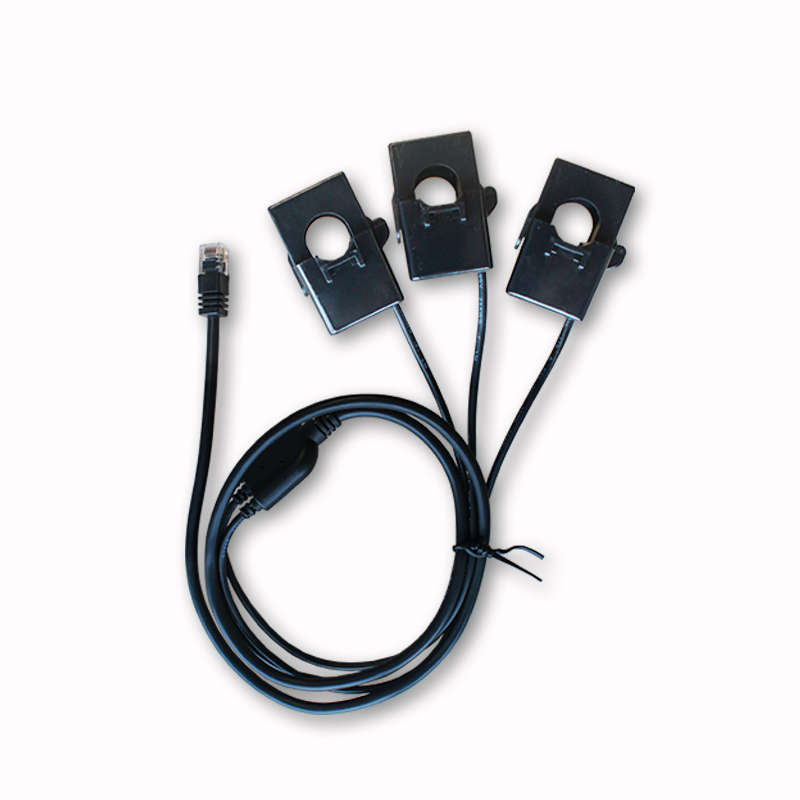 SEM3-WL CT Three-Phase Wi-Fi Energy MeterDIN-rail three-phase meter with three included CTs, Wi-Fi and RS485 Modbus, supporting one three-phase or three single-phase loads for compact wireless monitoring.View Product →
Datasheets look similar at a glance. These are the lines that decide whether a meter fits your project:
If the energy data is used to invoice someone, accuracy is no longer a preference — it is a legal requirement in most of Europe. MID certification is the usual benchmark for billing-grade electricity meters sold into EU markets, and it applies to the complete instrument, not just the measuring element. In North America, UL or ETL listing is typically what an inspector looks for, and for DC charging infrastructure in Germany the PTB and Eichrecht requirements add another layer on top.
Our practical advice is to decide early whether the meter is for information or for money. Buying a certified three-phase meter with wireless communication costs more upfront, but it avoids a situation where a metering point has to be replaced after the installation is complete. For internal energy management, an uncertified Class 1 unit is usually the sensible choice.
SDM630-WIFI MID-Certified Three-Phase Energy MeterMID-certified 100A direct-load three-phase meter with Wi-Fi, multi-parameter measurement, and pulse outputs for certified energy monitoring and remote reading.View Product →The steps below cover the mistakes we see most often in support tickets. Working through them in order saves a return visit.
A meter is only as useful as the paperwork behind it. Before committing to a model, download the datasheet and the user manual and read the register map — this tells you far more about the device than any product page. Every series we ship comes with datasheets, installation manuals and communication protocol documents, and we keep version numbers and revision dates visible so you can tell whether you are working from current information. You can browse the full set in our download library.
It is also worth checking that firmware updates and technical support will still be available when the project is three years old. We have been building electricity metering products for years and maintain documentation across the whole range, from single-phase DIN-rail units to multi-circuit measurement systems; you can read more about how we work if that background matters for your procurement process.
Choosing a three phase WiFi energy meter comes down to four decisions: how the current is measured, how fast the data must update, how the reading is transmitted, and whether the application needs certified accuracy. Get those right and the rest of the specification falls into place quickly. Get one wrong and you will usually discover it during commissioning, which is the most expensive place to find out.
If you are unsure which configuration suits a particular site, send us the supply details and a sketch of the metering point. Working out the right combination of meter, sensor and communication path is the part of the job we enjoy most.
Your email address will not be published. Required fields are marked *

We develop and produce high performance electricity meters, power analyzers, current sensors, communication modules and management systems.
Address:NO. 52, Dongjin Road, Nanhu, Jiaxing, Zhejiang, China
Copyright @ Eastron Electronic Co., Ltd. All rights reserved
