

 English
 Español
 Deutsch
 中文简体
中文简体
Product Consultation
Your email address will not be published. Required fields are marked *
Content
When selecting an energy meter for commercial or industrial use, the term "MID certified" appears frequently — but not everyone understands what it entails or why it matters. MID stands for the Measuring Instruments Directive (2014/32/EU), a European Union regulation that establishes mandatory accuracy and performance standards for measuring instruments used in trade and billing. A three phase MID energy meter that carries this certification has been independently tested and verified to meet strict metrological requirements, meaning its readings are legally valid for invoicing tenants, sub-metering energy costs, or complying with utility billing standards.
The directive sets out specific accuracy classes — most commonly Class B (equivalent to accuracy class 1) for active energy — and requires manufacturers to demonstrate conformity through notified bodies. For end users, this translates into confidence that the meter is not just technically functional, but legally defensible. In landlord-tenant energy billing scenarios, retail parks, industrial estates, and multi-unit commercial buildings, using a non-MID meter can expose operators to legal risk. The MID mark removes that ambiguity entirely.
Single phase meters are adequate for residential installations and small commercial loads. However, three phase power distribution is the norm in industrial facilities, large office buildings, manufacturing plants, and any site where heavy machinery, HVAC systems, or high-power equipment is in use. A three phase MID energy meter is engineered to measure energy consumption across all three phases simultaneously, providing a complete and accurate picture of total consumption.
Beyond simply reading three phases, these meters monitor the balance between phases, detect phase failures, and often measure reactive as well as active energy. This is important in facilities where unbalanced loads can lead to inefficiencies, equipment damage, or inflated utility bills due to poor power factor. A three phase meter captures data that a single phase unit simply cannot — making it the appropriate choice wherever three phase supply is present.
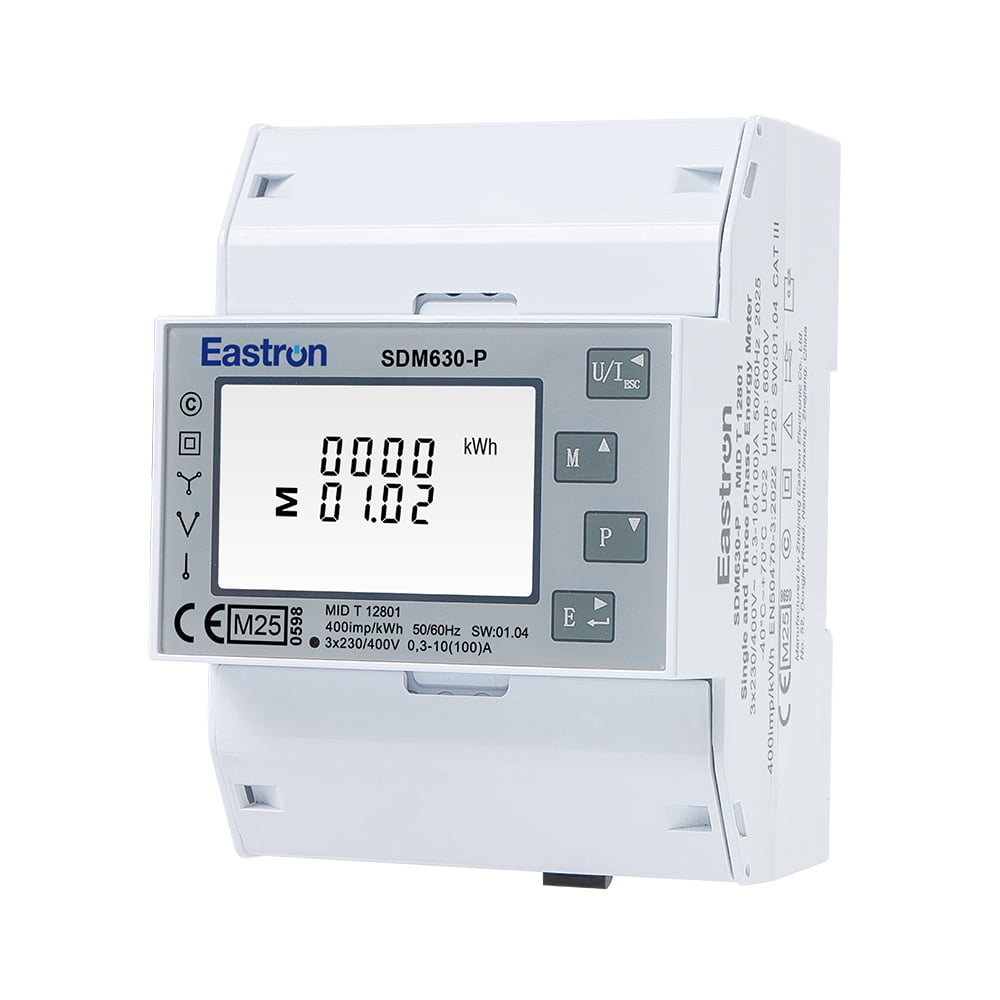
Not all three phase MID energy meters are built to the same specification. When comparing models, several technical parameters deserve close attention:
Three phase MID energy meters are found across a wide range of sectors, each with distinct requirements. The following table summarises common applications and the specific reasons MID certification is valuable in each context:
| Application | Why MID Certification Matters |
| Commercial landlord sub-metering | Legal billing of tenants requires certified metering |
| EV charging stations | Pay-per-use charging mandates MID-compliant meters |
| Industrial energy auditing | Accurate baseline data for ISO 50001 compliance |
| Retail and shopping centres | Transparent cost allocation between units |
| Renewable energy systems | Feed-in tariff claims require certified generation metering |
In each of these contexts, the meter is not merely a monitoring tool — it is a legal instrument. The MID certification ensures that both parties in a billing relationship can trust the figures displayed.
Correct installation is as important as the meter specification itself. A poorly installed meter — even one that is MID certified — can produce inaccurate readings or pose safety hazards. Several practical points should guide the installation process.
For loads up to 100A, direct connection is straightforward: the live conductors pass through the meter terminals. Above this threshold, current transformers must be installed around each phase conductor, with the meter's current inputs connected to the CT secondaries (typically rated at 1A or 5A output). It is essential that the CT ratio programmed into the meter matches the physical CTs installed — an incorrect ratio will cause systematic measurement error across all readings.
Most three phase MID energy meters are designed for DIN rail mounting inside a distribution board or metering enclosure. The IP rating of the enclosure must be appropriate for the installation environment — IP65 or higher for outdoor or dusty industrial environments, IP40 for protected indoor switchrooms. Adequate clearance around the meter terminals should be maintained to prevent overheating and to allow safe access during maintenance.
After installation, the meter should be commissioned by verifying that phase voltages, currents, and power factor readings are plausible given the connected load. Many meters include a test mode or pulse output that can be used to cross-check readings against a reference instrument. For billing applications, a commissioning record should be kept documenting the meter serial number, MID approval number, installation date, and CT ratios used.
Modern three phase MID energy meters are rarely deployed in isolation. In most commercial and industrial environments, they form part of a broader energy management infrastructure. Modbus RTU over RS-485 remains the most widely supported protocol, allowing multiple meters to be networked on a single bus and polled by a central data logger or building management system (BMS). Typical polling intervals range from 1 to 15 minutes, providing granular load profiles that support energy auditing and anomaly detection.
For facilities adopting IIoT (Industrial Internet of Things) architectures, meters with Modbus TCP or REST API interfaces allow data to flow directly into cloud-based energy management platforms. This eliminates the need for on-site data loggers and enables real-time dashboards, automated reporting, and consumption-based alerts. When selecting a meter for integration, it is worth confirming that the Modbus register map is fully documented and that the meter's firmware supports the required baud rates and parity settings of the host system.
A three phase MID energy meter is a long-service instrument — many models are rated for 10 to 20 years of continuous operation. However, periodic checks are advisable, particularly in billing applications where accumulated error over time could result in financial disputes. Most regulatory frameworks require periodic re-verification of trade meters, typically every 5 to 10 years depending on jurisdiction and meter class.
Practical maintenance tasks include inspecting terminal connections for signs of corrosion or loosening (which can introduce resistance and affect current measurement), verifying that CTs remain securely clamped around conductors, and checking that the meter display and communication interface remain functional. Meters installed in harsh environments — high humidity, vibration, or extreme temperature ranges — may require more frequent inspection. Keeping a maintenance log ensures accountability and supports any future audit or dispute resolution process.
The selection process should begin with a clear definition of the application requirements: maximum load current, supply voltage configuration, required measured parameters, communication needs, and the physical installation environment. From there, shortlisting meters that carry valid MID approval for the relevant accuracy class narrows the field considerably. It is worth verifying MID approval directly against the EU's official NANDO database or the manufacturer's declaration of conformity, rather than relying solely on product labelling.
Budget is a factor, but the lowest-cost option is not always the most economical over the life of the installation. A meter with a well-documented Modbus register map, reliable firmware, and responsive manufacturer support will save significant time during commissioning and troubleshooting. For large-scale deployments — metering dozens or hundreds of distribution boards — standardising on a single meter model simplifies procurement, spares management, and system integration considerably. Investing time in thorough specification at the outset avoids costly replacements or recertification down the line.
Your email address will not be published. Required fields are marked *

We develop and produce high performance electricity meters, power analyzers, current sensors, communication modules and management systems.
Address:NO. 52, Dongjin Road, Nanhu, Jiaxing, Zhejiang, China
Copyright @ Eastron Electronic Co., Ltd. All rights reserved
