

 English
 Español
 Deutsch
 中文简体
中文简体
Product Consultation
Your email address will not be published. Required fields are marked *
Content
With the rapid adoption of commercial and industrial (C&I) solar-plus-storage systems in recent years, system complexity has steadily increased. A significant industry shift has seen metering architecture move from a post-design selection step to the initial solution design phase. Previously, meters were selected only after the system architecture was finalized; however, with the widespread adoption of self-consumption models, peak-shaving arbitrage, and Energy Management Systems (EMS), data clarity and consistency have become decisive factors in overall system operational efficiency.
For solar-plus-storage integrators, the primary task is to clearly define the system’s metering objectives.
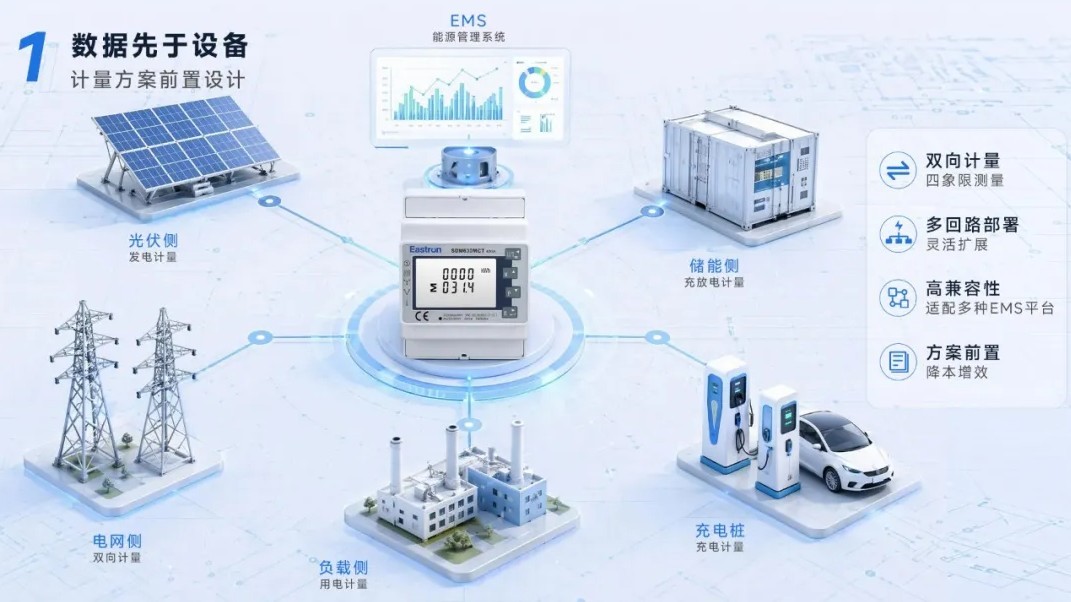
Traditional PV projects only required tracking power generation and consumption. With the addition of energy storage, however, metering complexity has surged due to the coexistence of multi-directional energy flows—including PV generation, grid intake, storage charge/discharge, and load consumption.
In real-world projects, metering nodes have distinct functional requirements. The PV, grid, storage, and load sides each have unique priorities that a single product cannot address; a comprehensive metering solution must accommodate bi-directional metering, multi-circuit deployment, and system compatibility.
Based on these practical needs, Eastron has developed a portfolio of smart metering products covering various application scenarios. For instance, the SEM series supports bi-directional and four-quadrant metering, meeting the complex energy flow requirements of solar-plus-storage systems. Meanwhile, products like the SEM-2L and SDM630MCT-ML are tailored for multi-circuit metering, enabling customers to flexibly deploy meters at various nodes according to their system architecture.
Once the solution is designed, the true test of a project often lies in on-site implementation.
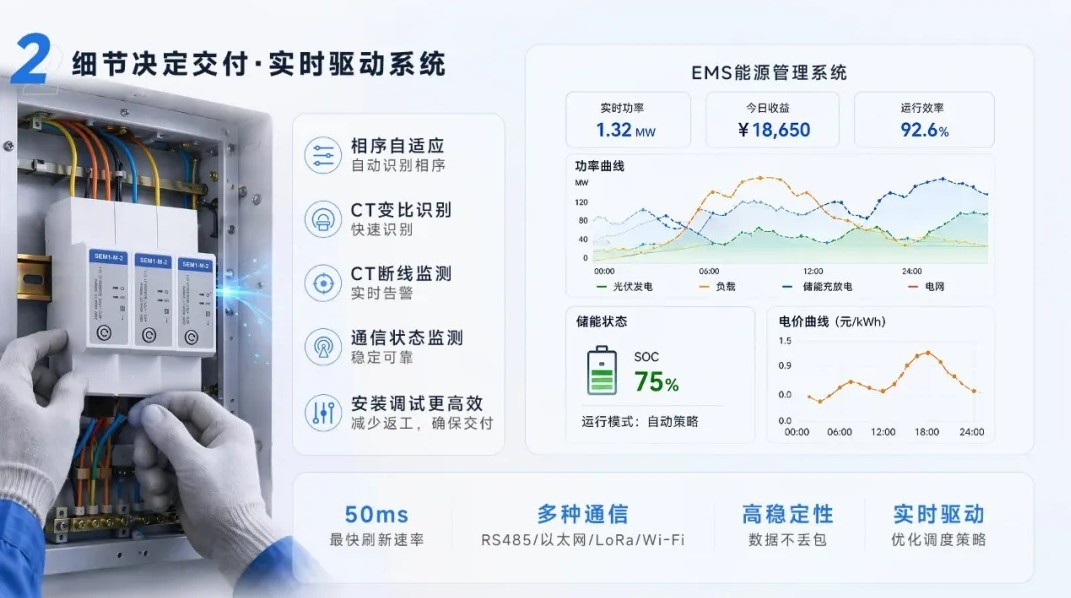
Customer feedback reveals that the most common on-site issues are not equipment failures, but rather data discrepancies, frequent EMS alarms, and excessive data deviations between devices. Troubleshooting often traces the root cause to minor oversights—such as reversed CT installation, incorrect phase sequencing, or errors in transformer ratio settings. These small issues consume significant engineering time and delay project delivery, with the impact becoming more pronounced in larger-scale projects.
We have therefore realized that superior metering equipment must go beyond mere measurement accuracy; it must also minimize uncertainty during on-site installation and commissioning. The Eastron SEM series features functions such as phase sequence self-adaptation, automatic CT ratio detection, and CT disconnection monitoring. These are designed with a core objective: to help engineers quickly pinpoint issues, minimize commissioning rework, and boost delivery efficiency.
While design and installation determine whether a project is successfully implemented, data quality becomes the true test once the system is operational.
As numerous PV-plus-storage systems integrate with Energy Management Systems (EMS) to enable functions like peak shaving, demand control, and energy storage scheduling, metering devices have evolved from mere “data recorders” into the foundation for real-time system decision-making.
Project experience shows that suboptimal scheduling performance often stems not from data accuracy issues, but from data latency and unstable communication; if an EMS receives delayed data, even the best strategies cannot be effectively executed. Consequently, high refresh rates, communication stability, and platform compatibility have become key criteria for system integrators during product selection.
Eastron continuously optimizes product performance to meet these needs: the SEM series supports data refresh rates as fast as 50ms, while the SDM630, SDM230, and SDM120 series achieve 100ms-level updates. Additionally, they support multiple communication protocols—including RS485, LoRa, M-Bus, Wi-Fi, and Ethernet—ensuring compatibility with a wide range of EMS and energy management platforms.
As a growing number of Chinese PV-plus-storage companies expand internationally, the challenges associated with metering solutions have shifted from the system level to the compliance level.
In markets like Europe and the US, for instance, MID and UL certifications—along with local energy metering standards—are mandatory prerequisites for project implementation. For integrators, a robust metering solution must not only meet on-site operational needs but also assist clients in satisfying local certification requirements.
Today, many overseas clients prioritize verifying product certifications; these certifications are not merely conditions for market entry but are directly linked to compliance regarding project acceptance, energy settlement, and long-term operation and maintenance. While continuously refining product performance, Eastron is also expanding its global certification portfolio: its flagship smart meters have all achieved MID certification, with the SDM230, SDM630, and SDM630MCT series also securing UL certification. Additionally, the SDM630-EV and DCM6 series—designed specifically for the German market—have obtained PTB certification, and wireless communication products have achieved RED certification, helping customers significantly reduce the time and cost associated with cross-market certification.
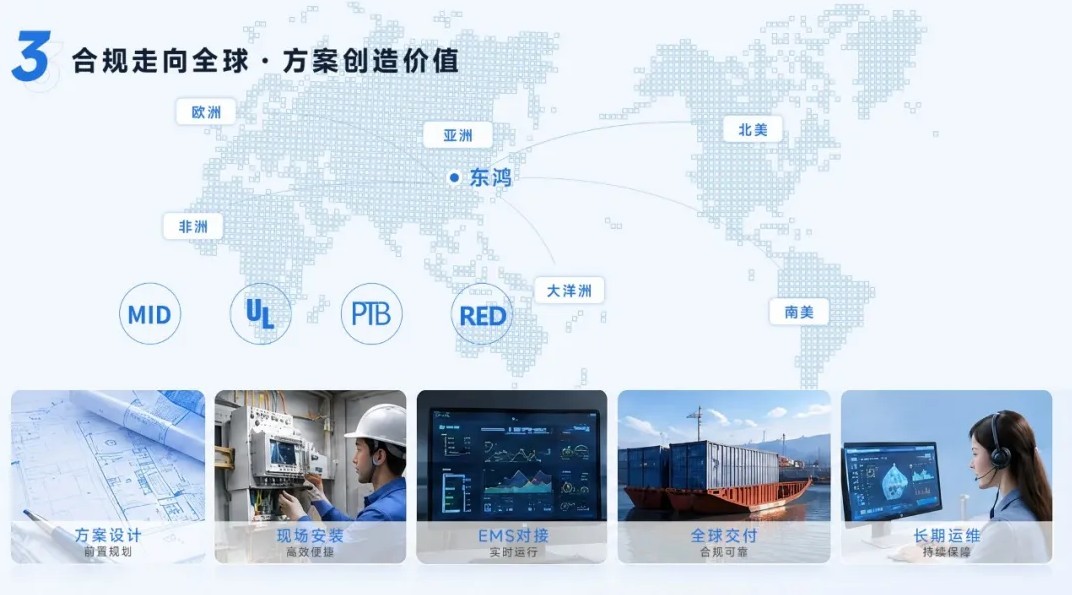
A review of numerous projects reveals that the value of metering equipment extends far beyond “accurate measurement” alone.
It plays a pivotal role throughout the entire project lifecycle: influencing the soundness of system design and the efficiency of on-site delivery, determining the effectiveness of EMS scheduling, and serving as a critical foundation for regulatory compliance in overseas projects.
This is why system integrators are re-evaluating their approach to metering solutions; they are no longer simply purchasing individual meters, but rather acquiring comprehensive smart metering solutions that cover the project’s entire lifecycle.
From architectural design to on-site delivery, and from real-time data acquisition to global market compliance, Eastron consistently focuses on sectors such as PV, energy storage, EV charging, and energy management. By continuously enhancing its smart metering product portfolio, the company effectively addresses the practical challenges faced by customers in their projects.
Future competition in the PV and energy storage industries will be defined not merely by equipment performance, but by data capabilities—and reliable metering serves as the starting point for unlocking the full value of that data.
Your email address will not be published. Required fields are marked *

We develop and produce high performance electricity meters, power analyzers, current sensors, communication modules and management systems.
Address:NO. 52, Dongjin Road, Nanhu, Jiaxing, Zhejiang, China
Copyright @ Eastron Electronic Co., Ltd. All rights reserved
