

 English
 Español
 Deutsch
 中文简体
中文简体
Product Consultation
Your email address will not be published. Required fields are marked *
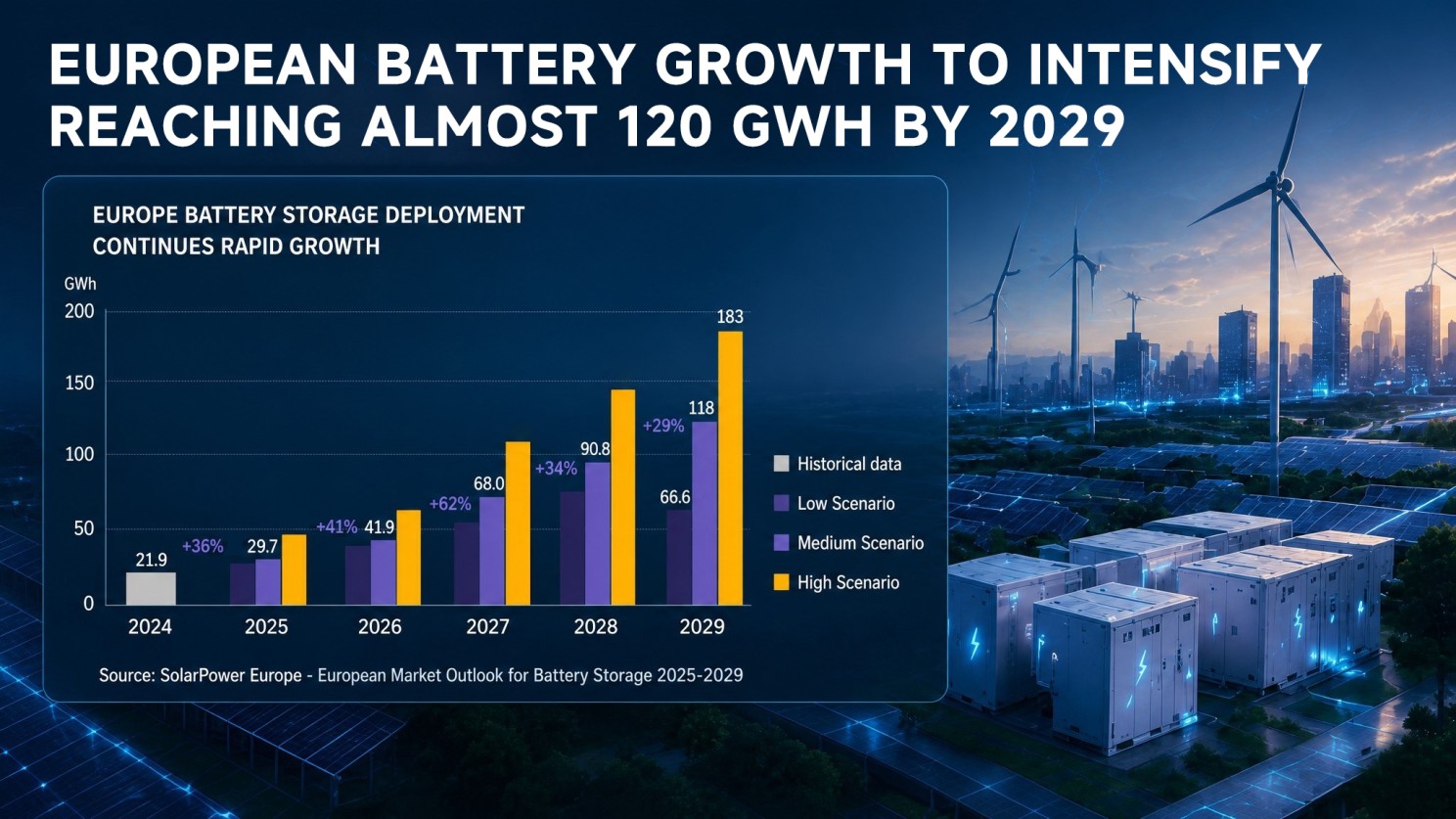
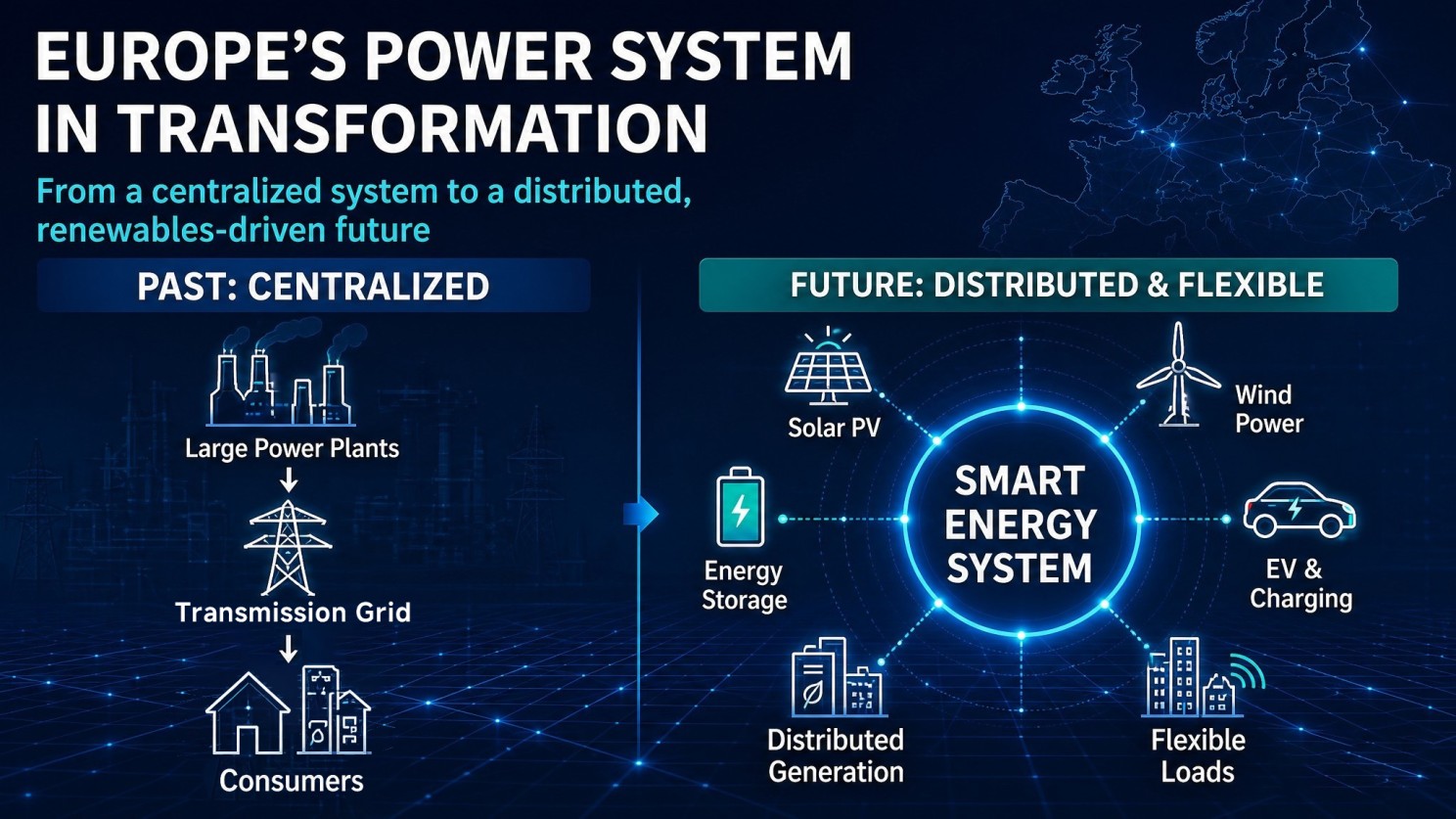
According to the IEA Electricity 2026 report and Ember's European Electricity Review, the European power system is undergoing a structural transition toward high shares of variable renewable energy.
Solar PV and wind power continue to account for the majority of new electricity generation capacity additions across Europe. In several markets, renewable generation is increasingly displacing conventional power during peak production hours, reshaping system operation patterns.
This evolution is not limited to generation mix transformation. It is progressively redefining the operational logic of power systems, shifting from centralized dispatchable generation toward distributed, variable, and digitally coordinated energy systems.
Co-evolution of Solar PV and Energy Storage
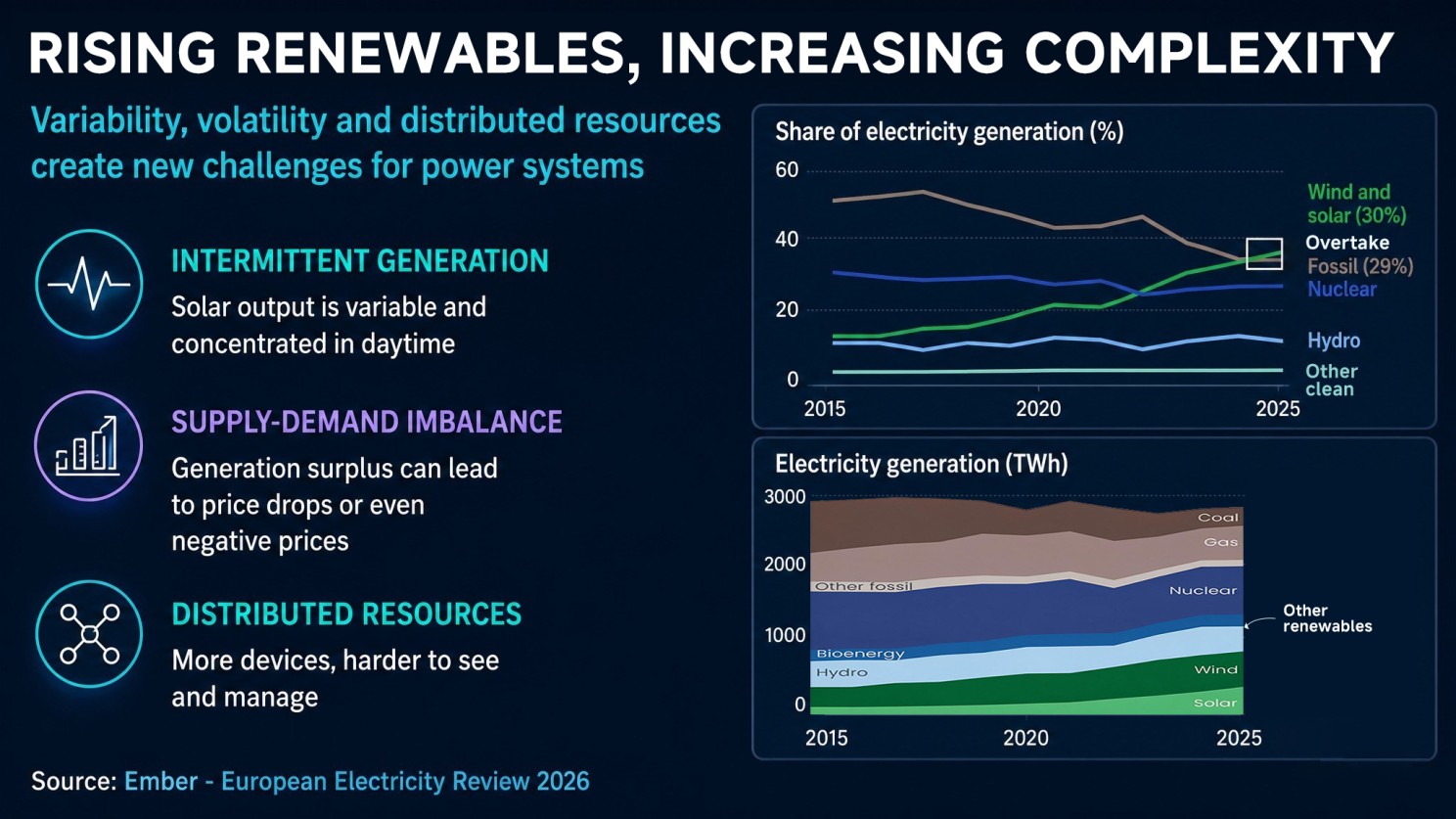
Data from SolarPower Europe’s European Market Outlook for Battery Storage 2025-2029 highlights that Europe’s battery energy storage market has entered a phase of sustained high growth, becoming one of the fastest-growing segments in the energy transition.
This growth is structurally linked to the increasing penetration of solar PV. As solar generation expands, system flexibility requirements rise accordingly, accelerating the deployment of battery storage as a key balancing resource.
The relationship between solar PV and storage is therefore evolving from a complementary configuration into a tightly coupled system architecture, forming the backbone of the emerging European power system.
Evolution of Energy Metering Infrastructure
Against this backdrop, energy metering systems are undergoing a fundamental functional evolution.
Traditionally, electricity meters served primarily as billing and settlement devices. However, in distributed energy systems, energy flows have become bidirectional and highly dynamic, requiring metering infrastructure to evolve into real-time data acquisition nodes within the power system.
Modern electricity metering systems are no longer limited to recording final consumption values. They are increasingly required to capture continuous energy flow dynamics across generation, consumption, and grid injection.
In commercial and industrial energy systems, particularly in configurations combining solar PV, battery storage, and variable loads, high-precision measurement becomes a critical enabler of system optimization.
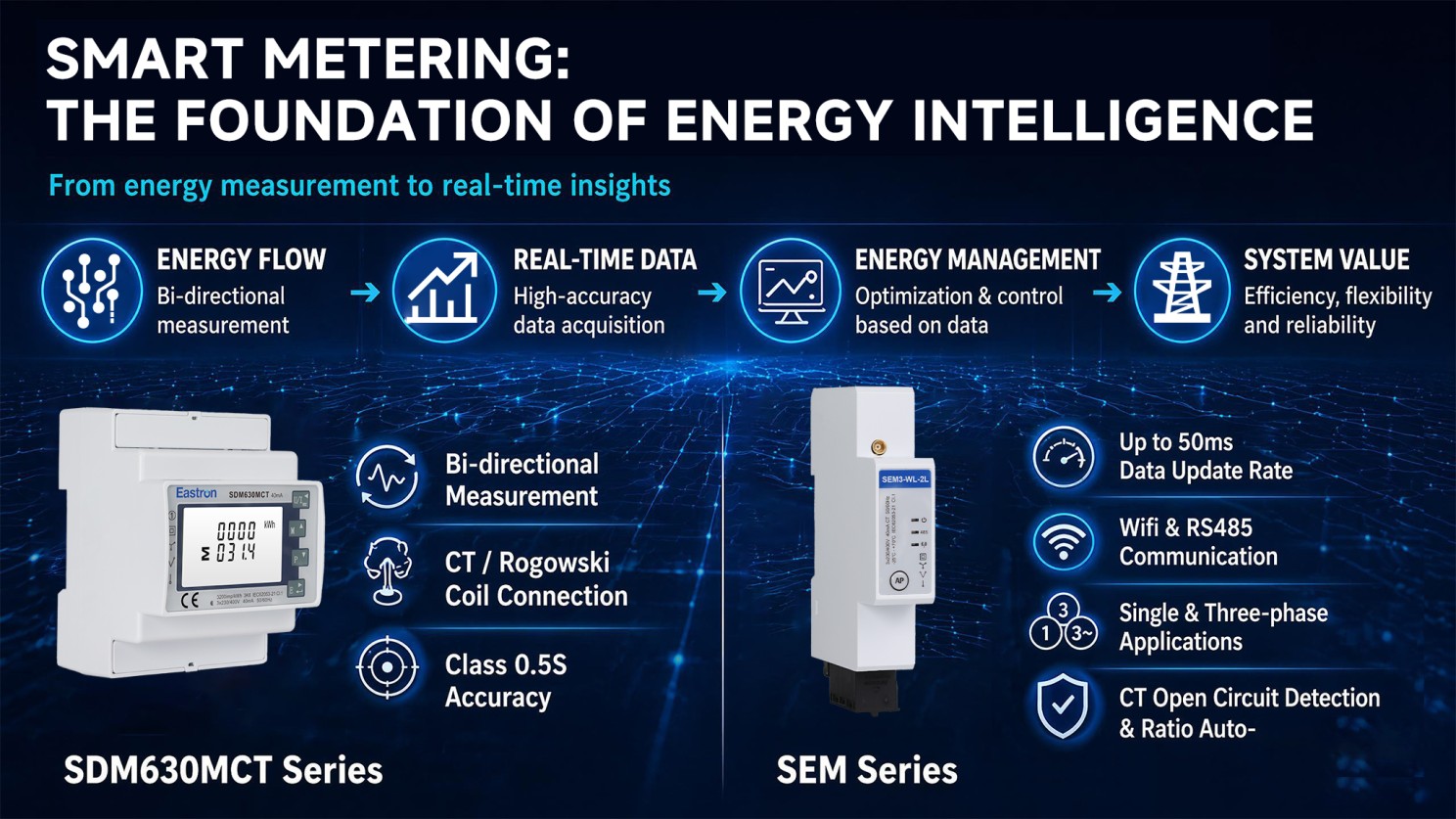
For example, in industrial and commercial applications, the SDM630MCT series energy meter is widely used for three-phase metering in distributed energy systems. With support for CT and Rogowski coil integration, it enables accurate measurement across different current ranges while delivering class 0.5S accuracy. This provides reliable real-time data inputs for energy management systems (EMS), supporting battery charging/discharging strategies and load optimization in commercial and industrial environments.
In residential and small-scale storage systems, energy flows are more dynamic and distributed. In these scenarios, the SEM series smart meter is applied for household-level energy monitoring. Supporting both single-phase and three-phase loads, with data update rate up to 50ms and communication via WiFi or RS485, it enables real-time visibility of solar generation, household consumption, and grid export. This makes it suitable for integration with residential energy management systems and inverter-based architectures.
In both cases, the role of the electricity meter extends beyond traditional billing functionality. It becomes a foundational component of distributed energy system visibility, enabling high-resolution energy data acquisition across the system.
Energy Data Infrastructure as a System Enabler
As Europe continues to increase the share of renewable energy in its power mix, the operational paradigm of the energy system is shifting further.
System constraints are no longer defined solely by generation capacity or installed assets, but increasingly by system observability and controllability. Solar PV provides energy input, battery storage provides dynamic balancing, grid infrastructure enables coordination, while metering systems form the foundational data layer connecting all components.
In this architecture, system efficiency depends on the completeness, granularity, and real-time availability of energy data. Energy metering infrastructure—comprising smart meters and advanced electricity meters—is therefore becoming a critical enabler of distributed energy system operation.
From this perspective, metering is evolving from a settlement mechanism into a core layer of the digital energy system architecture.
Conclusion
The continued expansion of solar PV and energy storage in Europe is driving the power system toward a new operational paradigm. Increasing system complexity is redefining the core requirements of energy infrastructure.
The key capability of future energy systems is shifting from installed capacity toward system observability, flexibility, and data-driven dispatchability.
Within this transformation, energy metering infrastructure plays an increasingly strategic role. Smart meters and advanced energy meters are evolving from traditional measurement devices into foundational components of the distributed energy system, enabling the transition toward a more digital, flexible, and data-driven power system.
Your email address will not be published. Required fields are marked *

We develop and produce high performance electricity meters, power analyzers, current sensors, communication modules and management systems.
Address:NO. 52, Dongjin Road, Nanhu, Jiaxing, Zhejiang, China
Copyright @ Eastron Electronic Co., Ltd. All rights reserved
