

 English
 Español
 Deutsch
 中文简体
中文简体
Product Consultation
Your email address will not be published. Required fields are marked *
Content
In traditional energy management models, enterprises typically assessed their energy usage through monthly electricity bills or periodic reports. While effective when the power structure was relatively stable, this approach is becoming inadequate as the share of new energy sources rises and the marketization of the power sector accelerates. A common realization is dawning on enterprises: the bottleneck in energy management is shifting from “insufficient equipment capacity” to “a lack of real-time data.”
Real-time energy data is evolving from mere supplementary information into a fundamental capability for energy system operations.
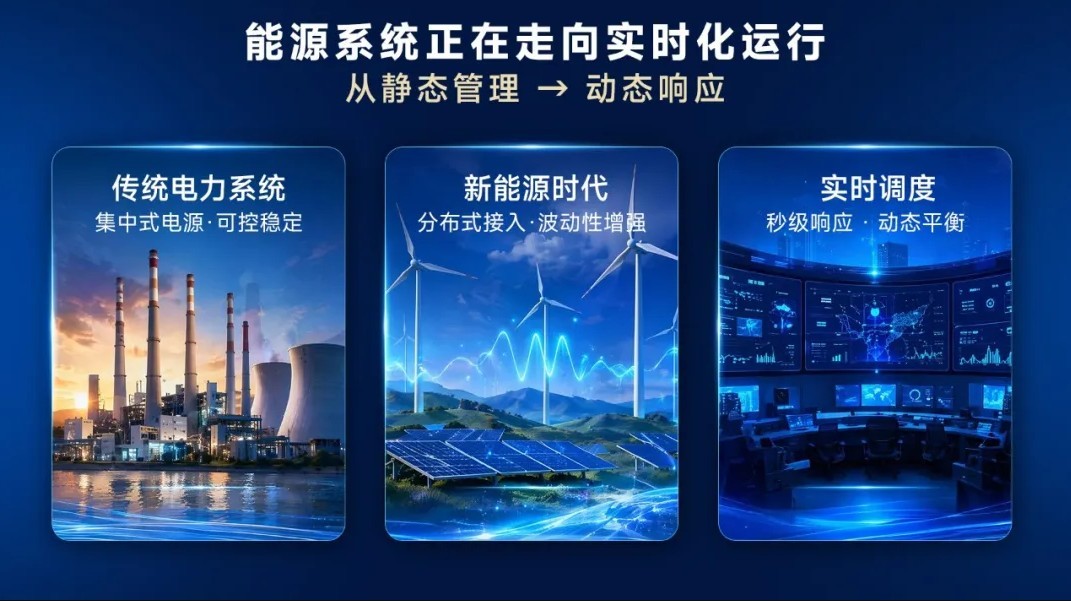
Changes in energy systems stem primarily from structural adjustments on the supply side. With the large-scale integration of solar power, wind power, and distributed energy storage, power system stability is shifting from a state of “controllable supply” to one of “dynamic fluctuation.”
Traditional power systems relied on centralized power sources with clear, stable dispatch paths; in contrast, new energy sources are inherently intermittent, requiring power balancing to be dynamically adjusted over much shorter timeframes.
Against this backdrop, the energy system is no longer a static structure but a dynamic, constantly changing entity. Maintaining stable operation requires the ability to perceive electricity consumption and generation states in real time.
The significance of real-time energy data lies not merely in “seeing electricity usage faster,” but in fundamentally altering how energy management decisions are made.
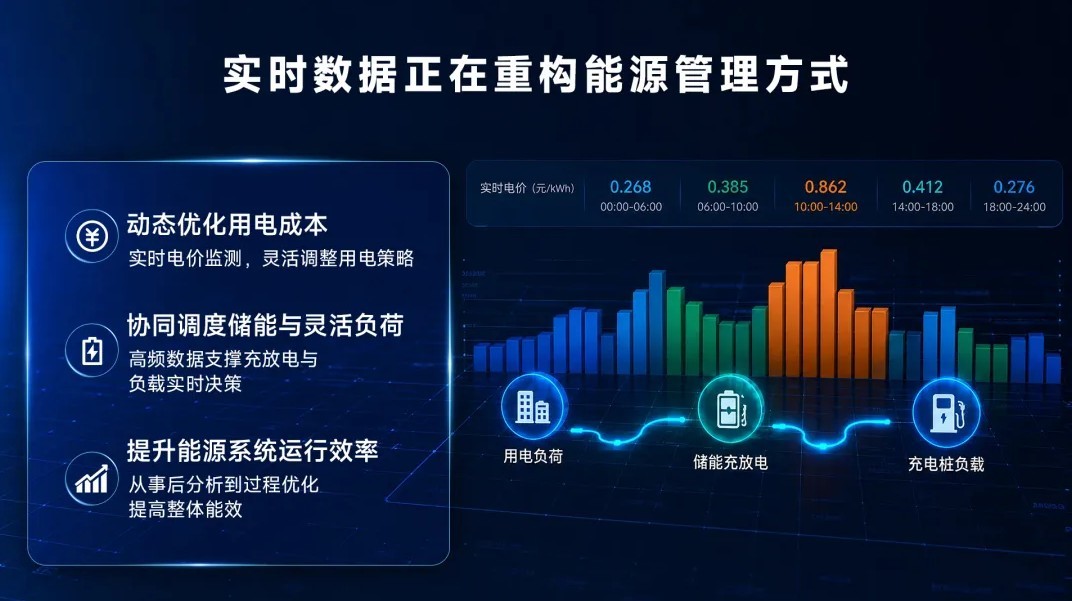
As electricity pricing mechanisms become increasingly market-driven, time-of-use and spot pricing are becoming the norm, with the cost difference for the same unit of electricity widening across different time periods. This shifts the focus of electricity usage from “aggregate volume management” to “temporal optimization.”
In this environment, the core value of real-time data manifests in three key areas:
Dynamic optimization of electricity costs. Enterprises can flexibly adjust their consumption strategies based on real-time prices and load conditions, thereby reducing overall energy costs.
Supporting the coordinated dispatch of energy storage and flexible loads. Whether determining charge/discharge strategies for energy storage systems or managing loads at charging stations and data centers, real-time decision-making relies on high-frequency data.
Enhancing the overall operational efficiency of the energy system. In increasingly complex energy networks, real-time data enables a shift from “post-event analysis” to “in-process optimization,” thereby improving overall energy efficiency. Fundamentally, real-time energy data is transforming energy systems from mere “statistical tools” into “operational tools.” This process is extending data acquisition requirements from the system level down to the level of individual field devices.
As energy systems transition into the era of real-time operation, the role of traditional electricity metering devices is changing.
In the past, the core function of an electricity meter was metering and billing; in today’s energy landscape, smart meters are evolving into the “data gateway” for energy systems.
This means meters are no longer just terminal devices that record electricity consumption; they must now possess enhanced data acquisition capabilities, superior communication efficiency, and the versatility to adapt to diverse energy scenarios—such as photovoltaic (PV) systems, energy storage systems, EV charging infrastructure, and industrial/commercial microgrids.
The value proposition of metering devices has expanded from mere “metering accuracy” to encompass “data real-time capability” and “system connectivity.”
Driven by this trend, smart meters themselves are undergoing continuous upgrades.
Take the Eastron SEM series of Energy meters, for example: they support data update rates as fast as 50ms, providing high-frequency, continuous real-time data for PV, energy storage, and energy management systems. This enables systems to detect load changes and operational fluctuations more promptly, thereby enhancing responsiveness in energy dispatch and optimization. Additionally, the series features multiple communication interfaces and excellent system compatibility, making it suitable for a wide range of energy applications.
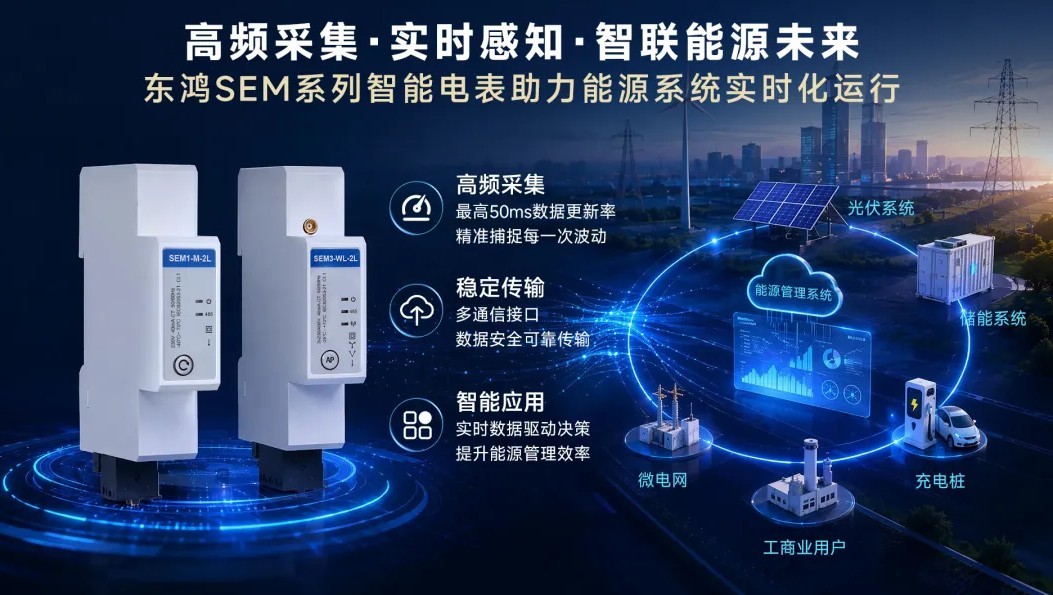
As energy systems increasingly operate in real-time, smart meters capable of high-frequency data acquisition—such as the Eastron SEM series—are becoming vital foundational components of digital energy systems.
Viewed broadly, the energy industry is shifting from being “equipment-driven” to “data-driven.”
Future competition within energy systems will hinge not merely on power generation capacity or equipment scale, but on the ability to acquire and utilize energy data in real-time.
In this context, real-time energy data is no longer just information; it is becoming an integral part of the energy system itself. For energy management, the true transformation lies not simply in “seeing faster,” but in the system’s ability to operate in real-time.
Your email address will not be published. Required fields are marked *

We develop and produce high performance electricity meters, power analyzers, current sensors, communication modules and management systems.
Address:NO. 52, Dongjin Road, Nanhu, Jiaxing, Zhejiang, China
Copyright @ Eastron Electronic Co., Ltd. All rights reserved
