

 English
 Español
 Deutsch
 中文简体



Product Consultation
Your email address will not be published. Required fields are marked *
Electricity meters are responsible for measurement, while communication systems handle data transmission. As the demand for electricity monitoring and energy management continues to grow, determining how to efficiently transmit energy data to management systems has become a key consideration in project design. Wi-Fi offers a convenient method for the wireless transmission of such data.
What advantages does Wi-Fi offer compared to traditional wired communication? And what role does it play in the context of smart meter applications?
More Convenient Connectivity
Smart meters often utilize interfaces such as RS485 for data communication, requiring physical cables to connect to data-collection equipment or a host system. In retrofit projects for existing buildings, the addition of such wiring can lead to extra construction work.
Wi-Fi, by contrast, can leverage existing on-site wireless networks for data transmission, eliminating the need to install dedicated communication cables. This approach simplifies installation in settings such as residential energy monitoring or small-scale commercial facilities.
However, when a meter is installed inside a metal distribution box, wireless signals may be compromised; therefore, signal coverage and network stability must be carefully considered in practical applications.
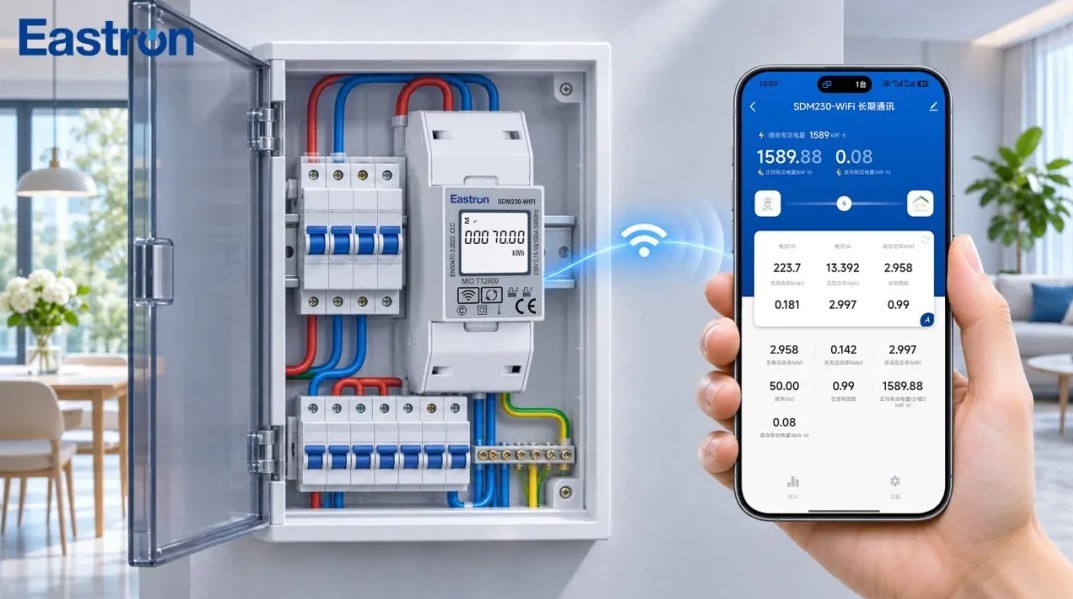
Remote Data Transmission
How can data measured by an electricity meter be transmitted to a mobile phone or a management platform? This process requires the coordination of a communication module, a network, and a receiving system.
Electricity meters equipped with Wi-Fi capabilities can connect to a wireless network and transmit measurement data to a corresponding system according to specific protocols. Once the network and platform are configured, users can remotely monitor parameters such as voltage, current, power, and energy consumption, thereby reducing the need for manual, on-site meter reading.
It is important to note that while Wi-Fi handles data transmission, the storage, visualization, and analysis of that data are managed by the associated system. The ability to connect to Wi-Fi does not automatically mean that an electricity meter supports cloud-based access.
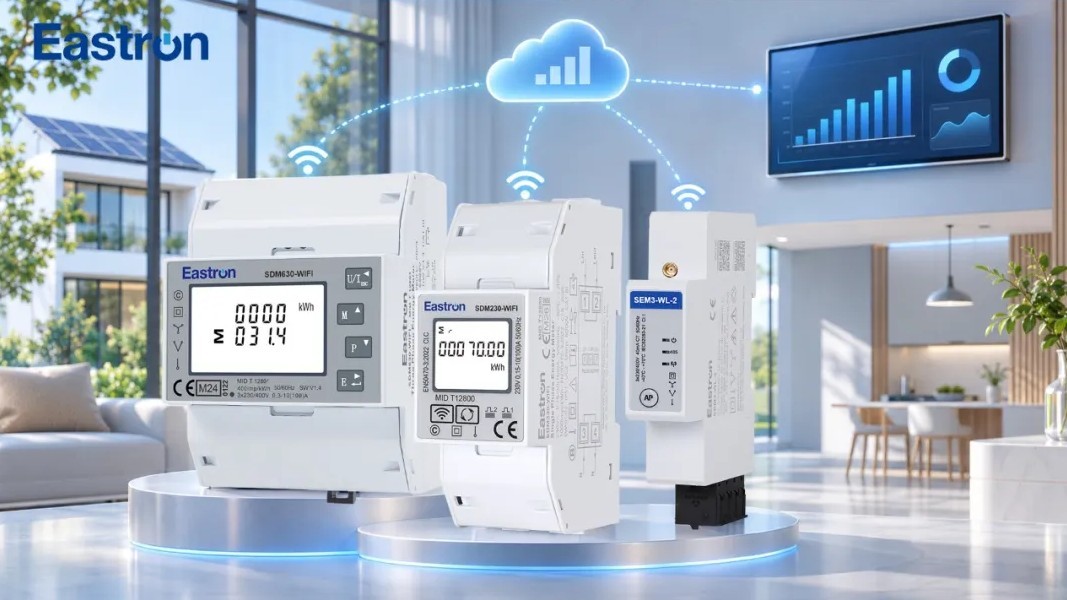
Supporting Solar, Storage, and Charging
In systems comprising solar photovoltaics (PV), energy storage, and charging infrastructure, key data points for energy management include grid power intake, PV power generation, and load consumption.
Smart meters equipped with metering capabilities can monitor electrical parameters and energy flow at the installation point, transmitting this data to an energy management system via Wi-Fi. By integrating operational information from other equipment, the system can analyze energy usage, providing data-driven insights for optimizing self-consumption of solar power, managing energy storage dispatch, and regulating charging loads.
Compared to solutions that require the installation of dedicated communication cables, Wi-Fi offers easier deployment in locations where a network is already available. However, implementing functions such as anti-backfeed (preventing power from flowing back into the grid) or controlling the charge/discharge cycles of energy storage systems requires additional components, including control hardware, compatible communication interfaces, and well-defined control strategies.
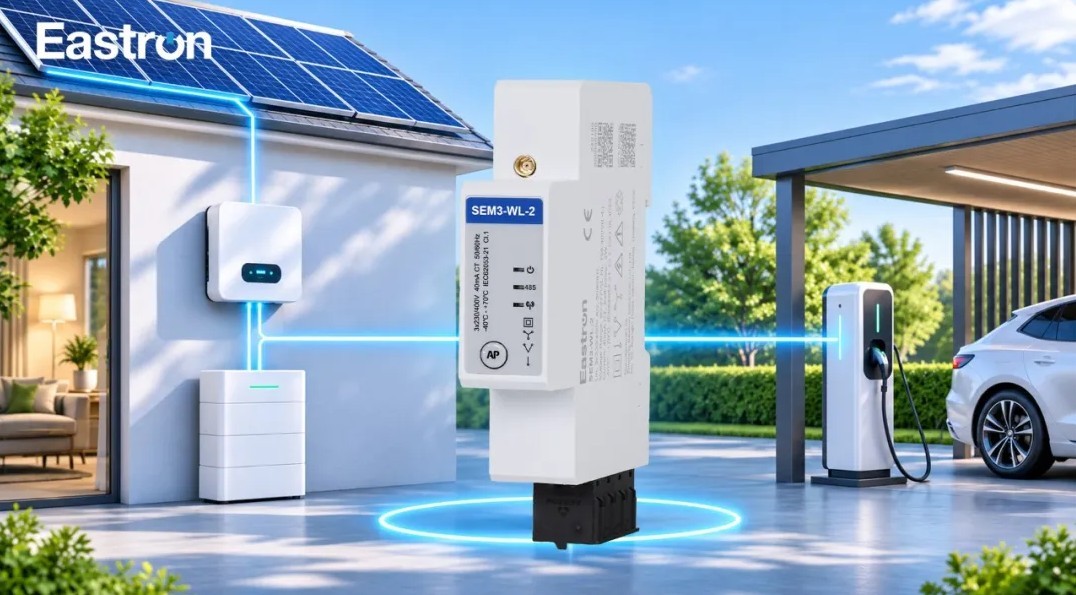
Choose Based on Actual Requirements
Wi-Fi is suitable for scenarios where a wireless network is already in place, and there is a desire to minimize physical cabling while enabling remote data access. RS485 is a well-established solution for connecting industrial equipment and networking multiple meters, while LoRa is ideal for applications requiring long-range wireless transmission.
The choice of technology should not be based solely on whether it is wired or wireless; one must also consider the installation environment, transmission distance, number of devices, and system compatibility. For electricity meters, the right communication solution is one that ensures metering data is reliably delivered to wherever it is needed.
Your email address will not be published. Required fields are marked *

We develop and produce high performance electricity meters, power analyzers, current sensors, communication modules and management systems.
Address:NO. 52, Dongjin Road, Nanhu, Jiaxing, Zhejiang, China
Copyright @ Eastron Electronic Co., Ltd. All rights reserved
