

 English
 Español
 Deutsch
 中文简体
中文简体
Product Consultation
Your email address will not be published. Required fields are marked *
Content
MID stands for the Measuring Instruments Directive (2014/32/EU), a European Union regulation that defines the legal and technical requirements for measuring instruments used in commercial and billing applications. For energy meters specifically, MID certification confirms that the device has passed rigorous accuracy tests and meets standardized performance criteria established by independent notified bodies across the EU. A meter bearing the MID mark — displayed as a capital M followed by the last two digits of the certification year — has been independently verified to measure electrical energy within defined error tolerances across a wide range of real-world operating conditions.
It is important to distinguish MID-certified meters from general-purpose or sub-metering devices that simply measure electricity. A non-MID meter may display accurate readings under ideal conditions but lacks the legally traceable calibration documentation and formal approval that regulators, utilities, and landlords require when billing a third party for energy consumption. In essence, MID certification is what separates a measurement tool from a legal measurement instrument.
MID energy meters for active electrical energy are classified under Annex MI-003 of the directive. This annex defines two primary accuracy classes relevant to most commercial and residential installations:
| Accuracy Class | Maximum Permissible Error | Typical Application |
| Class A | ±2% | Residential households, basic landlord billing |
| Class B | ±1% | Commercial properties, multi-tenant buildings |
| Class C | ±0.5% | Industrial sites, high-consumption tariff billing |
These error limits apply not just at rated current and voltage, but across a specified range of loads, temperatures, and power factors. This breadth of testing is precisely why MID-certified meters carry legal standing: the certification confirms consistent performance, not just peak performance under controlled lab conditions.
Across EU member states, MID-certified meters are legally mandatory wherever energy readings are used as the basis for invoicing a third party. This covers a broad range of scenarios that go beyond the obvious utility billing context. Common applications that require MID-compliant instruments include:
Using a non-MID meter in any of these situations exposes building owners and energy managers to legal liability, potential billing disputes, and invalidated invoices. Regulatory bodies in countries such as Germany, the Netherlands, France, and the UK (prior to post-Brexit adjustments) have all enforced MID requirements in commercial sub-metering contexts.
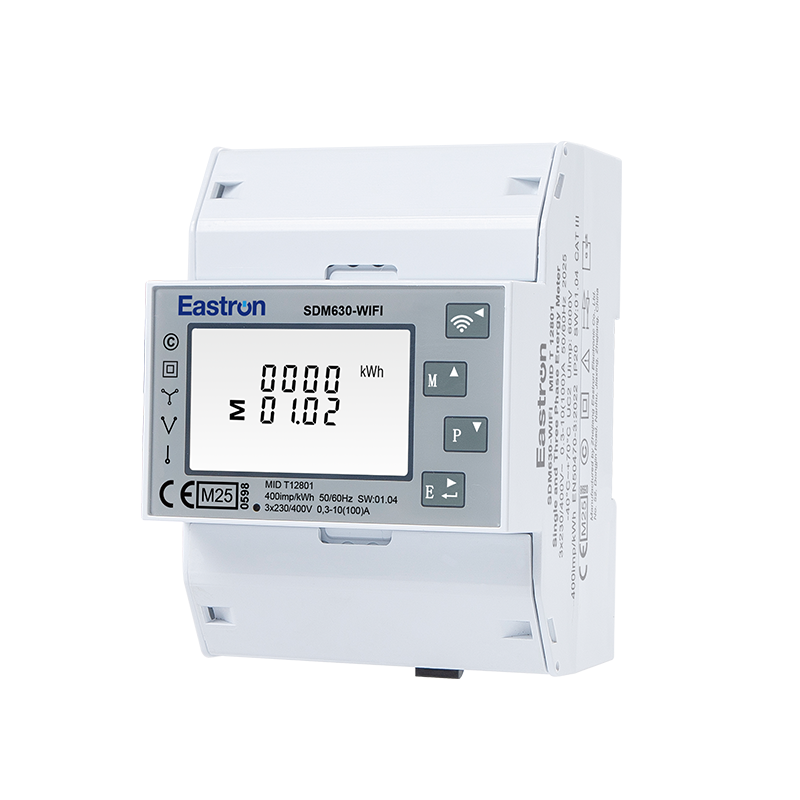
Not all MID-certified meters are equal in terms of functionality. The certification establishes a floor for accuracy and legal compliance, but the practical suitability of a meter depends on a set of technical and installation-specific criteria. Evaluating these factors before purchase prevents costly replacements and integration problems down the line.
Single-phase MID meters are suited for residential units, small commercial outlets, and individual machine connections drawing up to around 100A. Three-phase meters are required for larger commercial and industrial consumers with balanced or unbalanced three-phase loads. Some three-phase models offer separate current measurement per phase along with total active and reactive energy, giving energy managers a granular breakdown useful for load balancing and power quality analysis.
Direct-connection MID meters handle the full load current through the device and are typically available up to 100A. For higher currents — common in industrial applications — CT-connected (current transformer) meters work with external current transformers to scale down the measured current to a standard 1A or 5A secondary signal. When specifying a CT-connected MID meter, both the meter and the current transformers used with it must carry appropriate MID or equivalent approvals for the billing combination to remain legally valid.
Modern MID energy meters commonly support one or more communication protocols that enable remote reading and integration with energy management systems. The most widely supported options include Modbus RTU over RS-485, M-Bus (wired or wireless), pulse output (S0 interface), and increasingly, Modbus TCP or DLMS/COSEM over Ethernet or LTE. Choosing the right communication interface depends on the existing infrastructure of the building or site. For large multi-tenant installations, wireless M-Bus or NB-IoT connectivity can significantly reduce cabling costs while maintaining MID-compliant data chains.
Most residential and light commercial MID meters use a compact DIN rail form factor, typically 1 to 4 DIN module widths, making them straightforward to install within standard distribution boards. Industrial and utility-grade meters are often panel-mounted units with larger displays and more robust enclosures rated to IP54 or higher. The form factor should be matched to the available installation space and the ambient conditions of the meter location, particularly in outdoor or damp environments.
One of the fastest-growing deployment contexts for MID energy meters is the multi-tenant building, whether a residential apartment block, a mixed-use commercial property, or a managed industrial estate. In these environments, a head meter supplied by the utility measures total building consumption, and individual MID sub-meters allocate consumption to each unit. This arrangement, often called landlord metering or check metering, relies entirely on the legal accuracy of the sub-meters to generate defensible tenant invoices.
Energy management software platforms aggregate data from multiple MID meters using their communication interfaces to produce automated monthly billing reports, consumption dashboards, and anomaly alerts. When a tenant disputes a bill, the MID certification of the meter provides the legal basis to defend the measurement. Without this certification, even an accurate reading has no legal standing in a billing dispute. Building managers who have retrofitted existing sub-metering infrastructure with MID-certified alternatives consistently report a reduction in billing disputes and faster resolution when disagreements do arise.
MID certification is not a permanent status. Most EU member states require periodic verification of energy meters used in legal-for-trade applications, with recalibration or replacement intervals typically set between 8 and 16 years depending on national metrology regulations. Germany, for example, mandates reverification under the Mess- und Eichgesetz (Measurement and Calibration Act), while the Netherlands and France have their own national transpositions of the MID requirements that set different timelines for specific meter categories.
In practice, many building operators choose to replace aging meters rather than have them recalibrated, since modern MID meters offer improved communication capabilities and accuracy classes compared to units installed a decade ago. Maintaining a meter register — a spreadsheet or CMMS record of each meter's serial number, certification date, installation location, and scheduled reverification date — is a straightforward way to stay ahead of compliance deadlines and avoid gaps in legal billing continuity.
Before purchasing and installing a MID energy meter, working through the following points will prevent the most common specification and compliance errors:
Selecting a MID energy meter is not simply a procurement decision — it is a legal and technical commitment to measurement integrity. Approaching the selection process with the same rigor applied to the billing system it feeds will ensure that the infrastructure supports both accurate energy management and defensible invoicing for the full operational lifetime of the installation.
Your email address will not be published. Required fields are marked *

We develop and produce high performance electricity meters, power analyzers, current sensors, communication modules and management systems.
Address:NO. 52, Dongjin Road, Nanhu, Jiaxing, Zhejiang, China
Copyright @ Eastron Electronic Co., Ltd. All rights reserved
