

 English
 Español
 Deutsch
 中文简体
中文简体
Product Consultation
Your email address will not be published. Required fields are marked *
Content
Accurate energy measurement is the foundation of fair billing, efficient energy management, and regulatory compliance in residential, commercial, and light industrial applications. The single phase MID energy meter has become the standard instrument for these tasks across the European Union and in many countries that align with European measurement standards. Whether you are a utility operator, electrical contractor, facility manager, or EV charging station installer, understanding what a MID-approved single phase energy meter is, how it works, and how to select the right one for your application is increasingly important as energy monitoring requirements grow more rigorous.
MID stands for the Measuring Instruments Directive — specifically, Directive 2014/32/EU, which replaced the original 2004/22/EC directive and governs the design, manufacture, and verification of measuring instruments used for legal trade and billing purposes within the European Economic Area. For an energy meter to carry the MID mark, it must pass a conformity assessment process conducted by a Notified Body — an independent testing organization designated by an EU member state — which verifies that the meter meets the accuracy, durability, and tamper-resistance requirements defined in the directive's Annex MI-003 for electricity meters.
The MID mark itself — the letter "M" followed by the last two digits of the year of approval, enclosed in a rectangular symbol — appears on the meter housing along with the identification number of the Notified Body that performed the assessment. This marking gives legal certainty that the meter's readings can be used for billing customers, settling energy trades, or verifying consumption for regulatory reporting purposes. A meter without MID approval may still measure electricity accurately, but its readings cannot legally form the basis of a financial transaction or regulatory submission in EU jurisdictions.
Accuracy class under MID is defined by a maximum permissible error (MPE) expressed as a percentage of the true value. For active energy measurement, Class A meters have an MPE of ±2% under reference conditions, Class B meters ±1%, and Class C meters ±0.5%. Most single phase MID meters used in residential and small commercial billing applications are Class B, while Class C instruments are specified for revenue-grade metering in higher-value applications where even small measurement errors represent significant financial sums over time.
Modern single phase MID energy meters are electronic instruments based on solid-state measurement circuits rather than the electromechanical Ferraris disc mechanism used in older induction meters. The measurement principle relies on sampling the instantaneous voltage and current waveforms at high frequency — typically several thousand samples per second — and computing their product to determine instantaneous power. Integrating this power value over time yields energy in watt-hours or kilowatt-hours.
The voltage signal is measured directly from the supply terminals through a precision voltage divider network. The current signal is measured using either a current shunt resistor — a precision low-resistance element whose voltage drop is proportional to current — or a current transformer integrated into the meter housing. Shunt-based designs are compact and accurate across a wide dynamic range, while transformer-based designs offer better isolation between the high-current path and the measurement electronics, which can simplify the overall circuit design.
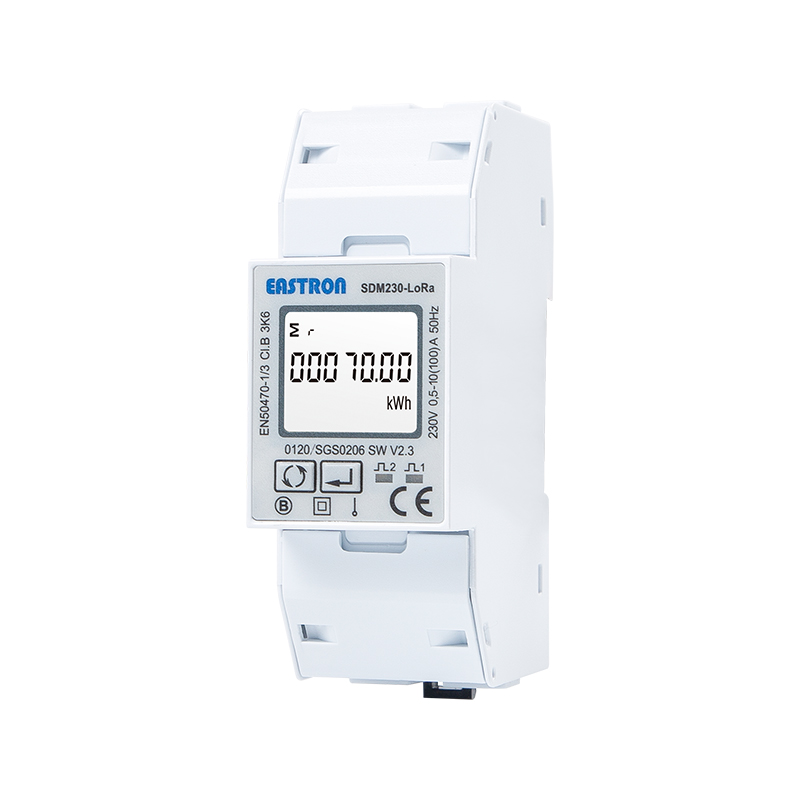
Both voltage and current samples are fed into a dedicated energy measurement integrated circuit — an application-specific IC (ASIC) designed specifically for power metering — which performs the multiplication, integration, and calibration compensation digitally. The resulting energy accumulation value is stored in non-volatile memory and displayed on an LCD or transmitted through a communication interface. Because the measurement is entirely electronic, there are no moving parts to wear, no magnetic calibration to drift, and no risk of the meter running backward due to reverse current flows — a feature that matters in installations with solar photovoltaic generation.
When selecting a single phase MID energy meter for a specific application, several technical parameters determine whether the meter will perform correctly and comply with all applicable requirements. The following specifications deserve careful attention:
| Parameter | Typical Values | Why It Matters |
| Rated Voltage | 230V AC ±20% | Must match supply voltage; tolerance ensures operation during grid fluctuations |
| Current Range (Ib/Imax) | 5(100)A, 10(100)A, 32(100)A | Base current (Ib) sets metering range; Imax defines maximum instantaneous current |
| Accuracy Class | Class A, B, or C | Defines maximum permissible measurement error for legal billing |
| Starting Current (Ist) | 0.4% of Ib typical | Minimum current at which the meter begins accumulating energy — affects measurement of very small loads |
| Frequency | 50 Hz / 60 Hz | Must match grid frequency; some meters auto-detect |
| Operating Temperature | -25°C to +55°C | Ensures reliable operation in outdoor enclosures and unheated locations |
| Display | LCD, 6–8 digits | Readability in all lighting conditions; backlit options available |
A significant differentiator between basic single phase MID meters and more advanced models is the availability and type of communication interface. Many modern MID-approved meters go well beyond simple local display of accumulated energy and offer data output capabilities that enable remote reading, integration with energy management systems, and billing automation.
The simplest and most universal communication method is an S0 pulse output — an open-collector transistor output that generates a fixed number of pulses per kilowatt-hour of energy consumed, typically 1000 imp/kWh. This pulse train can be connected to a data logger, building management system, or energy monitoring controller to accumulate energy data remotely. The S0 interface is standardized under DIN EN 62053-31 and is compatible with virtually all energy management hardware, making it a reliable and interoperable choice even in mixed-vendor environments.
RS-485 serial communication with Modbus RTU protocol is the standard interface for industrial and commercial energy monitoring applications. A single RS-485 bus can connect up to 32 meters (or more with repeaters) to a single controller or data gateway, with each meter identified by a unique address. Through Modbus registers, the controller can read not only accumulated energy but also real-time parameters including voltage, current, power factor, active power, reactive power, and apparent power. This rich data set enables detailed load analysis, power quality monitoring, and demand management beyond simple billing.
M-Bus (Meter Bus) is a European standard communication protocol designed specifically for reading utility meters — electricity, gas, water, and heat. It is widely used by utility operators and district energy suppliers for automatic meter reading (AMR) systems. M-Bus-equipped single phase MID meters can be integrated into existing meter reading infrastructure without additional protocol conversion, simplifying deployment in residential and small commercial metering applications at scale.
An increasing number of MID-approved meters include wireless communication modules — LoRaWAN, NB-IoT, Zigbee, or Wi-Fi — that enable data transmission without wired infrastructure. These interfaces are particularly valuable for retrofit metering in existing buildings where running communication cables would be disruptive and costly. Cloud-connected meters can upload readings at configurable intervals to web-based energy management platforms, enabling building owners and facility managers to monitor consumption, set alerts for unusual usage patterns, and generate automated billing reports.
The single phase MID energy meter serves a remarkably broad range of applications wherever accurate, legally defensible measurement of single phase electrical energy is required. The following are the most significant and growing application areas:
Correct installation is essential for a single phase MID meter to maintain its certified accuracy and remain legally compliant. MID approval covers the meter as a device but does not guarantee accurate readings if the meter is installed incorrectly or in unsuitable conditions. Several installation requirements apply universally.
Polarity must be strictly observed — single phase meters have clearly marked line and neutral terminals for both the supply input and the load output, and reversing polarity will produce incorrect or zero readings depending on the meter's design. The meter must be mounted in the orientation specified by the manufacturer, typically vertical with the display facing forward, as some current sensing designs are sensitive to mounting angle. Excessive vibration or mechanical shock can affect long-term calibration stability, so meters should not be mounted on surfaces subject to significant vibration without appropriate anti-vibration measures.
The meter's current rating must match the expected load. Installing a meter with a base current of 5A on a circuit that routinely draws 80A will not cause immediate failure — the Imax rating covers such loads — but operating continuously well above the base current rating reduces measurement accuracy and may shorten the meter's service life. Conversely, installing a high-current meter on a very low-load circuit means the meter will spend most of its time near its starting current threshold, where measurement accuracy is poorest. Selecting a meter whose base current rating corresponds to approximately 10–20% of the maximum expected load achieves the best accuracy across the typical operating range.
MID approval is not a permanent unconditional status — it applies to a meter of a specific approved type, and maintaining compliance requires that the physical meter in service remains in the condition and configuration it was in when approved. Tamper seals on the terminal cover and meter housing must remain intact. Any modification to the meter's firmware, calibration constants, or hardware — including adding unapproved communication modules — invalidates the MID approval. If a meter is damaged, repaired, or has its seals broken for any reason other than a sanctioned calibration check by an accredited laboratory, it must be recertified or replaced before being returned to legal metering service.
Most EU member states require periodic re-verification of legal meters at intervals set by national metrology authorities — commonly every 8 to 16 years for electricity meters. This re-verification involves testing the meter's accuracy against a reference standard and confirming that all tamper seals are intact. Keeping records of the meter's approval certificate, installation date, and any re-verification results is important documentation for regulatory inspections, energy audits, and dispute resolution. For meters used in critical billing applications, proactive replacement at or before the re-verification interval eliminates uncertainty and ensures continuous compliance without the cost and logistics of field re-verification programs.
Your email address will not be published. Required fields are marked *

We develop and produce high performance electricity meters, power analyzers, current sensors, communication modules and management systems.
Address:NO. 52, Dongjin Road, Nanhu, Jiaxing, Zhejiang, China
Copyright @ Eastron Electronic Co., Ltd. All rights reserved
