

 English
 Español
 Deutsch
 中文简体
中文简体
Product Consultation
Your email address will not be published. Required fields are marked *
3 Phase CT Meter Guide: How to Choose, Install and Wire CT-Operated Meters
Sep 28,2026
UL and ETL Listed Energy Meters: Safety Certification, Applications, and Buying Guide
Sep 21,2026
Smart Meter FAQ (Part 3) | Certification, Installation, and Procurement: Addressing 5 Practical Application Issues
Sep 20,2026Content
A DC energy meter is an instrument designed to measure, display, and record the flow of electrical energy in direct current systems. Unlike AC energy meters — which are standard in utility billing and household wiring — DC energy meters are purpose-built to handle the unique characteristics of direct current circuits, including unidirectional current flow, wide voltage ranges, and the high-current demands of battery banks, solar arrays, and industrial DC buses. As DC-powered systems grow more prevalent across solar energy installations, electric vehicles, battery storage systems, data centers, telecommunications infrastructure, and industrial automation, the need for accurate, reliable DC energy measurement has become a practical engineering requirement rather than an optional instrumentation choice.
At the most fundamental level, a DC energy meter multiplies the measured voltage across a circuit by the measured current through it to calculate instantaneous power in watts, then integrates that power value over time to produce an energy total expressed in watt-hours (Wh) or kilowatt-hours (kWh). In practice, modern DC energy meters do considerably more: they display real-time voltage, current, power, accumulated energy, state of charge for battery systems, run-time, and — in bidirectional models — separately track energy flowing in each direction, distinguishing between energy consumed and energy generated or returned to storage. This bidirectional measurement capability is indispensable in solar-plus-storage systems where the same circuit alternately carries charging current from solar panels and discharging current to loads.
Accurate energy measurement depends on accurate measurement of both voltage and current simultaneously. DC energy meters use well-established sensing techniques for each parameter, and the choice of current sensing method has a significant influence on the meter's accuracy, installation complexity, power consumption, and suitability for high-current applications.
DC voltage is measured by connecting the meter's voltage input terminals directly across the circuit being monitored, typically through a voltage divider network inside the meter that scales the input voltage down to a level suitable for the analog-to-digital converter (ADC). Most DC energy meters support voltage inputs ranging from a few volts up to 1,500V DC, with higher-voltage models designed for utility-scale solar and industrial DC bus applications. The meter's input impedance is designed to be high enough that the measurement circuit draws negligible current and does not disturb the circuit being monitored.
Current measurement in DC energy meters is accomplished by one of two primary methods. The first and most widely used is the shunt resistor method, in which a precision low-resistance resistor — the shunt — is inserted in series with the circuit. The voltage drop across the shunt, which is directly proportional to the current flowing through it per Ohm's Law, is measured by the meter and used to calculate current. Shunts are available in standard ratings from milliamps to thousands of amperes and offer excellent accuracy (typically 0.1% to 0.5% class) and stability over time, but they introduce a small resistive power loss in the circuit and require the meter's current input to be directly wired into the power circuit, which raises isolation and safety considerations at high voltages.
The second method uses Hall effect current sensors, which measure the magnetic field generated by current flowing through a conductor without requiring electrical contact with the power circuit. Hall effect sensors provide galvanic isolation between the measurement electronics and the power circuit — a significant safety and installation advantage in high-voltage DC systems. They can be fitted around existing conductors as clamp-on devices without breaking the circuit, making them ideal for retrofitting energy measurement into existing installations. However, Hall effect sensors are generally less accurate than precision shunts at low current levels and can be affected by external magnetic fields from adjacent conductors in dense cable trays.
DC energy meters are manufactured in a range of form factors and with different feature sets tailored to specific application categories. Understanding these types helps narrow the specification process to the products most appropriate for a given installation.
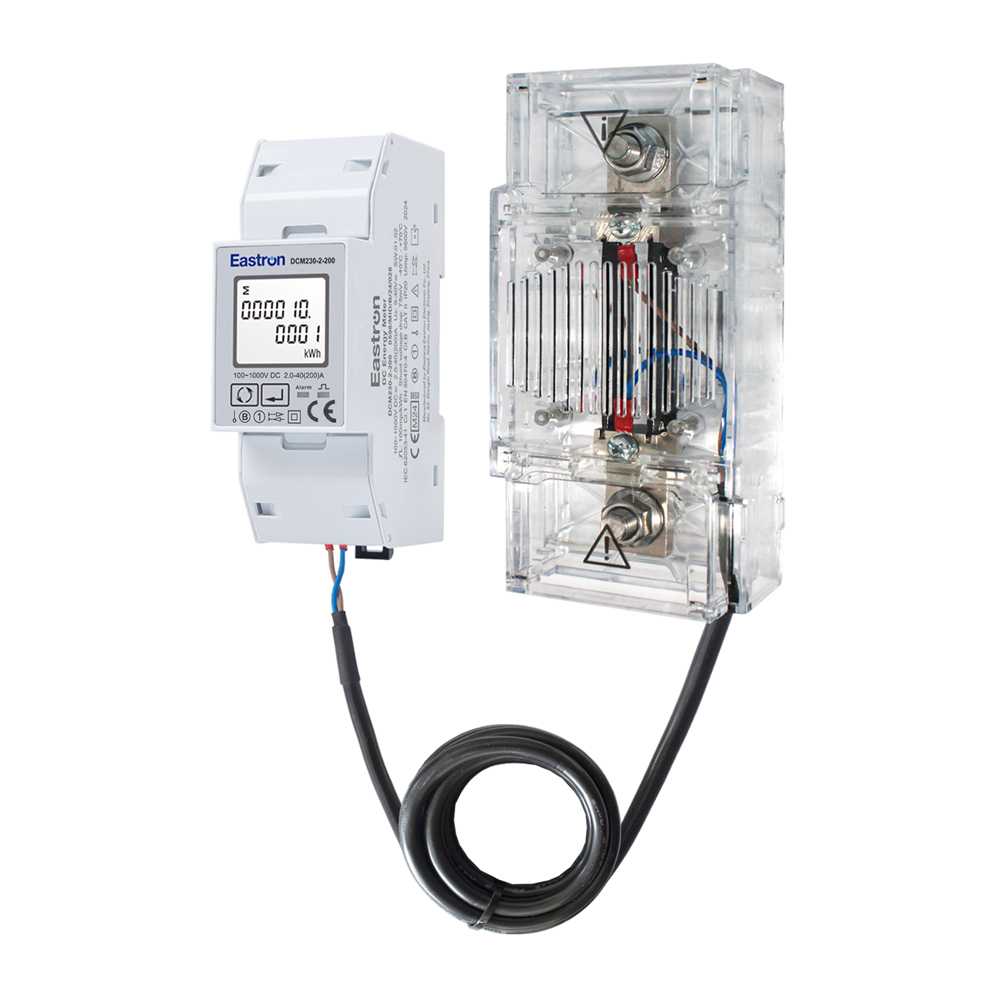
Selecting a DC energy meter requires careful evaluation of the technical specifications that directly affect measurement quality, installation compatibility, and long-term data reliability. The table below summarizes the most important parameters and their practical significance:
| Specification | What It Means | Practical Guidance |
| Voltage Input Range | Min and max DC voltage the meter can measure | Must exceed system maximum voltage including transients |
| Current Input Range | Max continuous current measurable (via shunt or sensor) | Select shunt rated above peak expected current |
| Accuracy Class | Maximum measurement error as % of reading or full scale | Class 0.5 or better for billing; Class 1.0 acceptable for monitoring |
| Bidirectional Capability | Ability to measure and separately log forward and reverse energy | Required for battery storage and solar self-consumption systems |
| Communication Interface | Protocol for remote data access (RS485 Modbus, CAN, Ethernet, pulse) | Match to SCADA, BMS, or energy management system requirements |
| Auxiliary Supply Voltage | Power supply input for meter electronics (may be self-powered from measured circuit) | Verify compatibility with available control supply voltage |
| Operating Temperature Range | Ambient temperature range over which accuracy specifications are maintained | Critical for outdoor solar and industrial installations |
Solar photovoltaic and battery energy storage systems represent the largest and fastest-growing application category for DC energy meters. In a typical residential or commercial solar-plus-storage system, DC energy meters are installed at multiple points in the circuit to provide a complete energy balance picture: at the solar array output to measure total generation, at the battery bank terminals to measure charge and discharge energy, and at the DC distribution bus to measure energy delivered to DC loads or to the inverter for AC conversion.
For solar applications, the DC energy meter at the array output must handle the open-circuit voltage of the series-connected panel strings — which can reach 600V to 1,500V DC in commercial and utility-scale systems — and must accurately measure current across the full range from near-zero at dawn and dusk to maximum power point current at peak irradiance. A meter with a wide dynamic range and low-current accuracy specification is particularly valuable in solar monitoring because a significant portion of daily energy generation occurs during the shoulder hours when current levels are well below rated maximum.
Battery storage applications place additional demands on the meter beyond simple energy totalization. Battery management requires knowledge of the instantaneous state of charge (SOC), which many advanced DC energy meters calculate using Coulomb counting — integrating the current flowing into and out of the battery over time — combined with voltage-based SOC estimation at rest. Accurate Coulomb counting requires high-resolution current measurement with minimal offset error, since small systematic errors in current measurement accumulate over thousands of charge-discharge cycles into significant SOC calculation errors.
In modern energy management systems, a DC energy meter that only displays local readings without providing digital data output is of limited value. Remote data access enables energy consumption analysis, fault detection, automated reporting, and integration with building energy management systems (BEMS), SCADA platforms, and cloud-based monitoring services. The most important communication interfaces found in DC energy meters include:
Correct physical installation is as important as correct specification in achieving accurate, reliable DC energy measurement. The following best practices should be followed during installation to avoid common errors that degrade measurement accuracy or create safety risks:
For applications where DC energy meter readings are used for commercial billing, energy purchase agreements, or regulatory compliance, the meter must carry appropriate legal metrology certification demonstrating that its accuracy has been independently verified to a defined standard. In Europe, the Measuring Instruments Directive (MID) — now implemented as the recast MID 2014/32/EU — covers DC energy meters used for EV charging billing under Annex MI-003, requiring an accuracy class of at least 1.0% and type approval testing by a notified conformity assessment body. In North America, ANSI C12.20 defines accuracy classes for electricity meters, and NTEP certification from the National Conference on Weights and Measures is required for legally-for-trade metering applications.
For non-billing monitoring applications — including solar system performance monitoring, battery state-of-charge tracking, and energy audit purposes — legal metrology certification is not required, but conformance to IEC 62053-41, which specifically addresses static DC energy meters for use in AC and DC supply systems, provides a useful benchmark for evaluating measurement accuracy and functional performance. When comparing meters from different manufacturers for monitoring applications, requesting the IEC 62053-41 accuracy class declaration and independent test report provides a more reliable basis for comparison than manufacturer specifications alone.
Your email address will not be published. Required fields are marked *

We develop and produce high performance electricity meters, power analyzers, current sensors, communication modules and management systems.
Address:NO. 52, Dongjin Road, Nanhu, Jiaxing, Zhejiang, China
Copyright @ Eastron Electronic Co., Ltd. All rights reserved
