

 English
 Español
 Deutsch
 中文简体
中文简体
Product Consultation
Your email address will not be published. Required fields are marked *
Content
When a facility engineer notices that a three-phase distribution board is running hotter than usual, an ordinary kWh meter only confirms that the circuit is consuming energy. It does not reveal whether the load is balanced, whether the power factor has dropped, or whether harmonic currents are overheating the neutral. A power analyzer fills that gap by measuring the main electrical parameters in a single panel-mounted instrument.
In the context of commercial and industrial installations, a power analyzer is a multi-function device that measures voltage, current, active and reactive power, apparent power, power factor, frequency, and often total harmonic distortion (THD). It is part measurement tool, part diagnostics instrument, and part sub-metering solution.
The working principle is straightforward: the analyzer samples voltage and current waveforms many times per cycle. In a three-phase system, it measures all three phases either directly for installations up to 100 A or through current transformers (CTs) and Rogowski coils for larger feeders. A digital signal processor then calculates RMS values, powers, power factor, and energy. The calculation also compensates for the phase angle between voltage and current, which is how the analyzer distinguishes active, reactive, and apparent power.
Because the calculations are based on continuous sampling rather than a single reading, a power analyzer can capture fluctuations and trends. That makes it useful for load profiling, detecting phase imbalance, and verifying power factor correction equipment.
The table below summarizes the parameters that matter most in day-to-day electrical monitoring.
| Parameter | What It Indicates | Typical Use Case |
|---|---|---|
| Voltage (V) | RMS level per phase | Monitor supply stability |
| Current (A) | Load magnitude per phase | Detect unbalanced loading |
| Active power (kW) | Real power consumed | Energy cost allocation |
| Reactive power (kVAr) | Non-working power | Power factor correction |
| Power factor | Efficiency of power use | Check PF improvement |
| Total harmonic distortion (THD) | Waveform distortion level | Assess harmonic pollution |
| Frequency (Hz) | Line frequency | Verify grid quality |
| Energy (kWh) | Consumed energy over time | Sub-metering and billing |
The exact set of parameters depends on the model. Some power analyzers also display maximum demand and four-quadrant energy, which is useful when the same feeder can both import and export power. For three-phase networks, several models sum the three phases and display a total value, which simplifies reporting. Others store minimum and maximum values between two reset periods for demand analysis.
With several form factors and communication options available, selecting the right power analyzer comes down to matching the meter to the installation and the data requirement.
Most panel-mount power analyzers follow standard DIN sizes such as 72x72 mm or 96x96 mm. The larger display makes it easier to read live values on a switchboard. For retrofit projects, the cutout dimensions and panel depth are the first constraints to check. A 96x96 unit remains the most common choice when the existing opening matches that size. A straightforward example is the RS485 Modbus 96x96 mm panel-mounted multifunction power analyzer, which covers the essential measurements in a standard cutout.
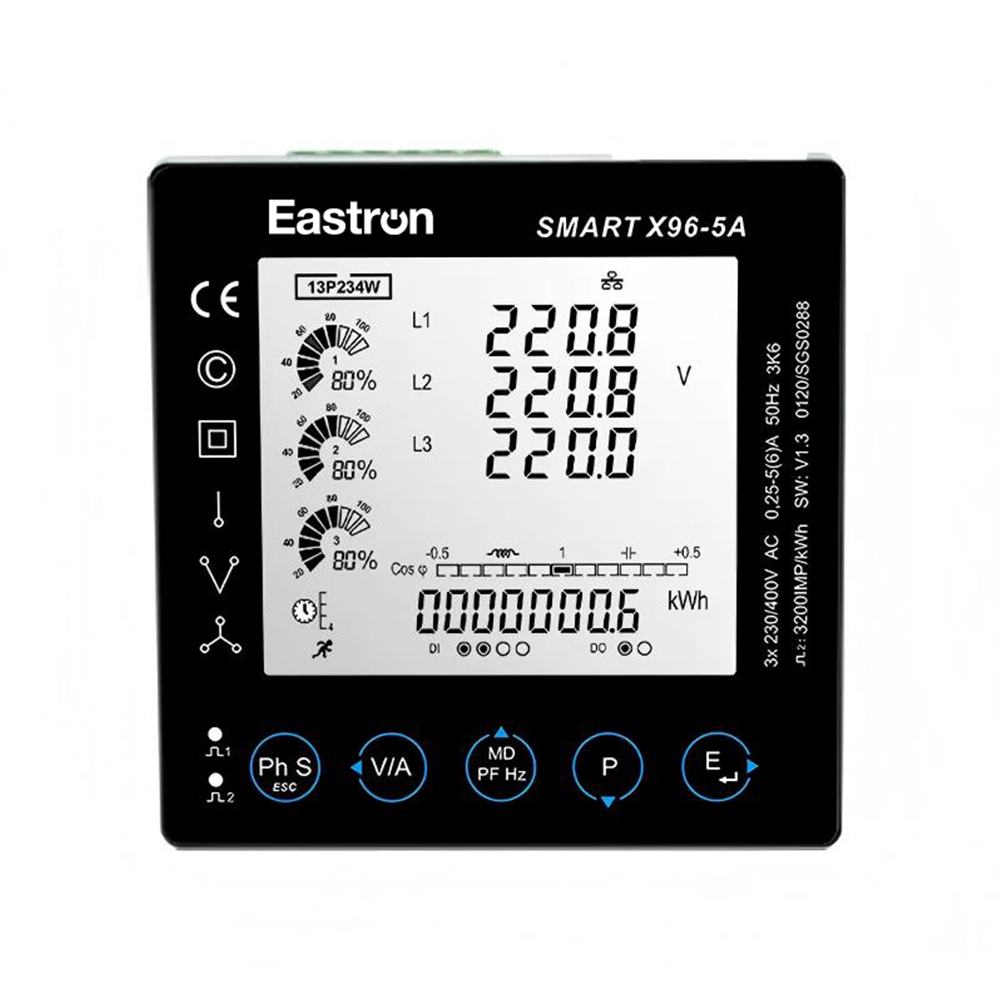 Smart X96-5A RS485 Modbus Panel Mounted Multi-function Power Analyzer ManufacturEastron is China Smart X96-5A RS485 Modbus Panel Mounted Multi-function Power Analyzer Manufacturers and Custom Suppliers, Factory,Eastro...View Product →
For sub-metering and energy allocation, Class 1.0 or Class 0.5S accuracy is typical. The 0.5S class is preferred when the analyzer is paired with CTs and readings are used for cost allocation or comparison against utility bills. The accuracy class refers to the active energy measurement; power quality parameters such as THD have their own specifications.
Direct connection is limited to currents such as 45 A or 100 A. For larger loads, CT inputs often rated 5 A secondary are the conventional solution. Rogowski coils are flexible and can be wrapped around busbars or large cables without disconnecting the installation, which makes them popular for retrofits. If you need to measure high-current feeders with minimal disruption, a 96x96 mm power analyzer with Rogowski coil input connects to flexible coils around the conductor.
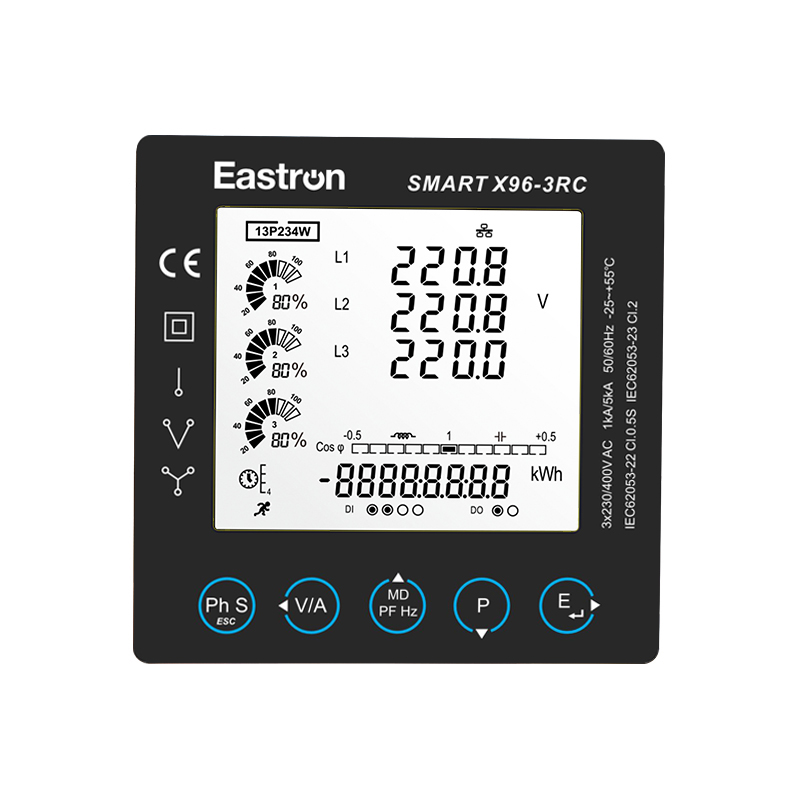 Smart X96-3RC Rogowski Coil Connect 96x96 Panel Mounted Multi-function Power AnaEastron is China Smart X96-3RC Rogowski Coil Connect 96x96 Panel Mounted Multi-function Power Analyzer Manufacturers and Custom Suppliers...View Product →
An analyzer that only displays values on its screen is fine for a manual walk-around, but most energy management projects require remote data collection. RS485 Modbus is the most universal protocol, while Ethernet/Modbus TCP fits directly into building or industrial networks. Some models also provide digital inputs for status monitoring and digital outputs for alarm and control. When the analyzer is part of a larger system, choose a protocol that your existing controller or SCADA already supports. This avoids extra protocol conversion and reduces integration cost.
If the data from the power analyzer will be used for billing, tenant sub-metering, or legal metrology, look for MID approval. MID stands for the European Measuring Instruments Directive, and MID-certified instruments follow metrological requirements for accurate and reproducible measurements across the EU. For purely internal monitoring, certification is less critical, but it adds credibility and simplifies approvals in regulated projects. For applications that need billable measurement, the MID-approved RS485 panel-mounted power analyzer provides the required assurance.
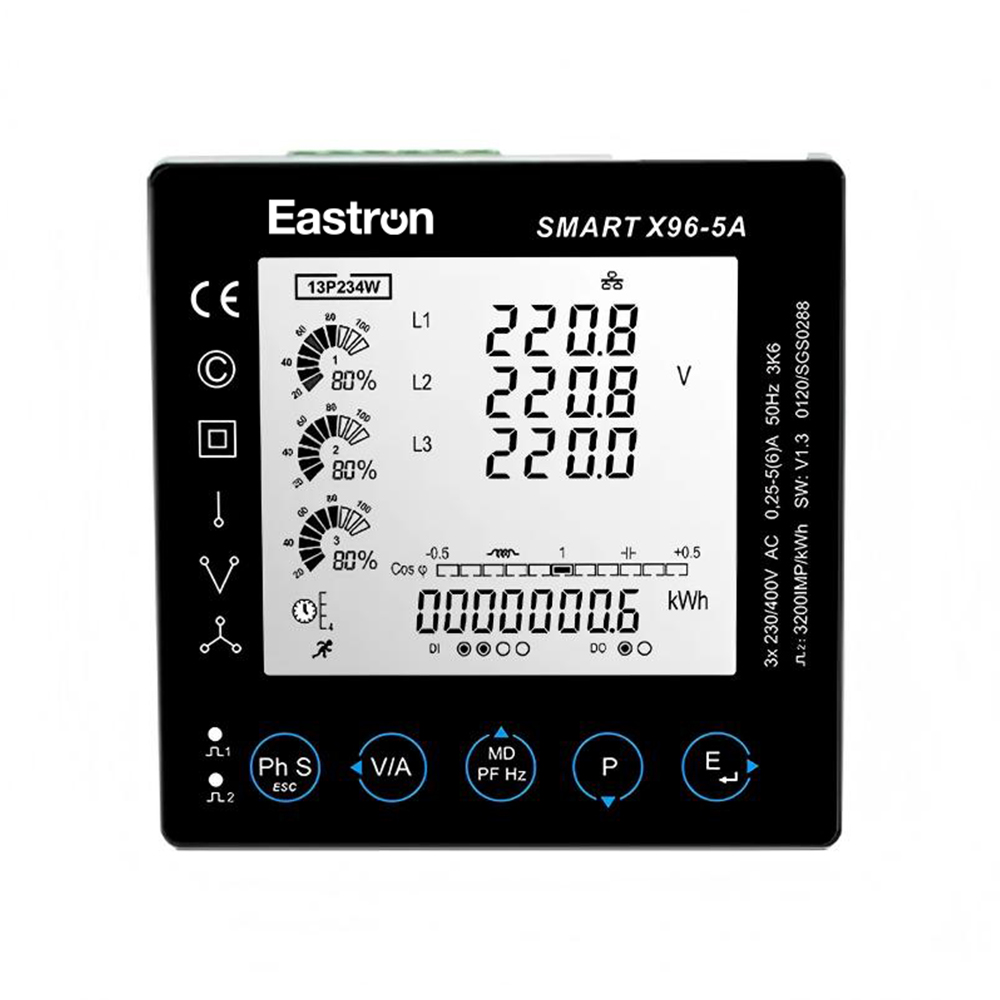 Smart X96-5A RS485 Modbus Panel Mounted MID Approved Power Analyzer ManufacturerEastron is China Smart X96-5A RS485 Modbus Panel Mounted MID Approved Power Analyzer Manufacturers and Custom Suppliers, Factory,Eastron ...View Product →
Panel-mounted power analyzers are used wherever electrical parameters need to be visible and recorded. Common locations include main distribution boards, sub-distribution panels, generator controls, uninterruptible power supply systems, and large machine feeders. In data centers, they support per-rack and per-row energy measurement; in EV charging stations, they help monitor charger input; in solar PV systems, they verify export and import flows.
Beyond basic monitoring, these analyzers feed data into building management systems and IoT platforms. With a gateway, RS485-based power analyzers can be connected over Ethernet or Wi-Fi, providing a practical path to central monitoring.
Power analyzers also help maintenance teams verify repairs. After re-torquing connections or replacing a capacitor bank, the display provides immediate confirmation that the power factor or current imbalance has improved.
A power analyzer is not an optional accessory when you need to understand a circuit; it is the difference between guessing and knowing. The right unit gives you accurate, continuous data and makes it easier to identify problems before they become failures. Start with your panel size, your current configuration, and the protocol you need. From there, the choice becomes much simpler, and a structured evaluation of your panel and communication requirements will point to a model that you can install once and rely on for years.
If you want to understand the engineering behind Eastron's measurement products, read the company background or download product datasheets and manuals from the download center for detailed specifications.
Your email address will not be published. Required fields are marked *

We develop and produce high performance electricity meters, power analyzers, current sensors, communication modules and management systems.
Address:NO. 52, Dongjin Road, Nanhu, Jiaxing, Zhejiang, China
Copyright @ Eastron Electronic Co., Ltd. All rights reserved
