

 English
 Español
 Deutsch
 中文简体
中文简体
Product Consultation
Your email address will not be published. Required fields are marked *
Content
In PV energy storage systems, the electricity meter is a crucial yet often overlooked core component; it directly impacts metering accuracy, the precision of electricity billing, the quality of energy data acquisition, and the efficiency of system operation and management.
Issues such as data discrepancies, equipment incompatibility, and errors in revenue calculation encountered in some PV projects are often closely linked to improper meter selection or a lack of system compatibility.
This article outlines the selection logic for PV meters across various application scenarios and matches specific products to each context, helping you make quick, accurate choices, mitigate project risks, and ensure smooth project execution.
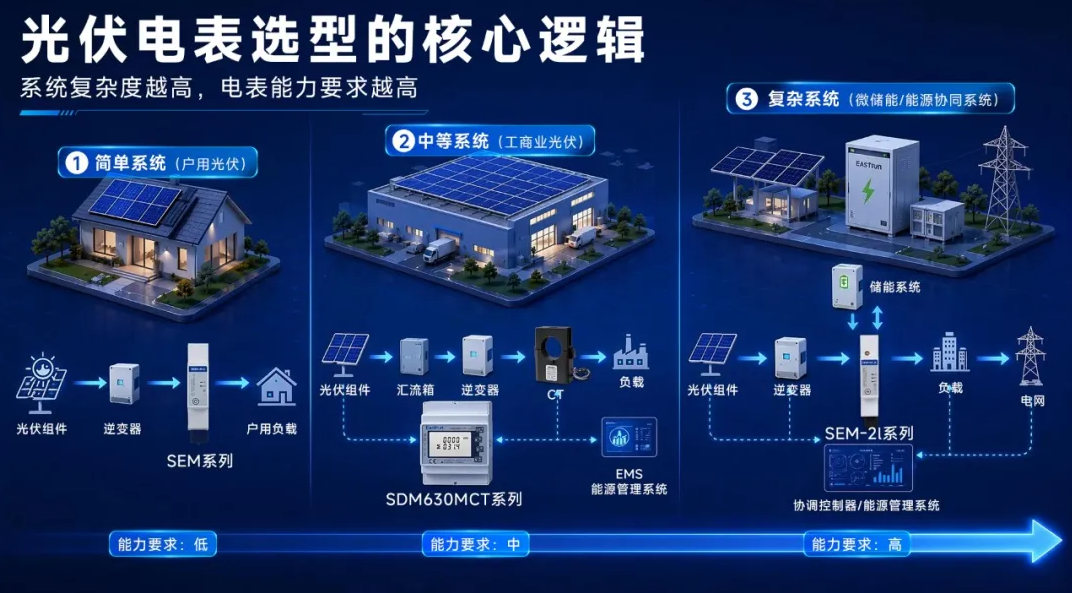
The fundamental principle of PV meter selection is to match the meter specifications to the complexity of the PV energy storage system.
The more complex the system—characterized by diverse energy flows and high requirements for equipment coordination—the higher the demands placed on the meter regarding metering accuracy, data refresh rates, communication capabilities, and system compatibility. PV meters have evolved from simple metering devices into core nodes for data acquisition and intelligent control within energy systems. Based on system complexity, they can be broadly categorized into three types:
Simple systems (Residential PV)
Medium-complexity systems (C&I PV)
Complex systems (Micro-energy storage / Integrated energy systems)
Typical Applications
Residential rooftops, small-scale distributed PV systems
Key Selection Criteria
Self-consumption, grid feed-in of surplus power, low cost, ease of installation
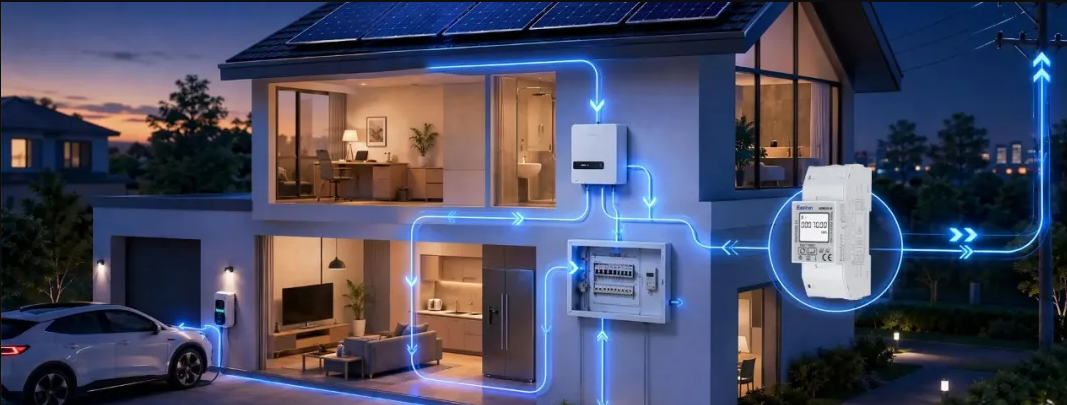
Residential PV systems typically prioritize ease of installation, bidirectional metering capabilities, and remote data monitoring.
Recommended Products
Eastron SEM Series:
Supports single-phase/three-phase residential PV applications; enables precise bidirectional metering and tracks power generation and consumption.
Supports dual communication (WiFi/RS485) for remote data acquisition and O&M management.
50ms high-speed data refresh rate meets real-time home energy monitoring needs.
Compact size fits residential distribution spaces, ensuring easier installation.
Eastron SDM230 Series:
Designed specifically for single-phase residential scenarios; supports bidirectional metering and currents up to 100A.
Class 0.5 / Class C accuracy meets high-precision metering requirements.
MID/UL certified, meeting application requirements for overseas markets.
Typical Applications
Factory rooftops, industrial parks, commercial buildings
Key Selection Criteria
Self-consumption optimization, electricity billing, sub-metering, EMS integration
C&I projects typically involve higher power ratings and more complex energy management needs, requiring support for high-current metering, system communication, and multi-scenario applications.
Recommended Products
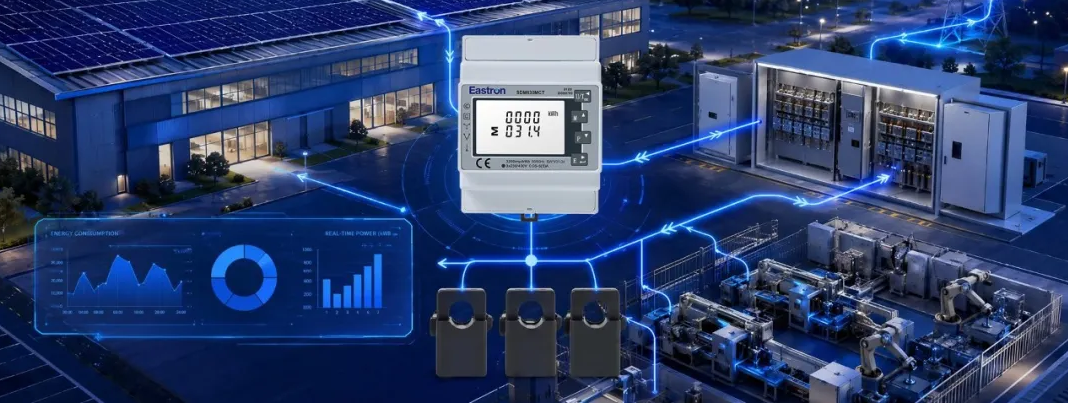
Eastron SDM630MCT Series:
Supports CT/Rogowski coil inputs; suitable for high-capacity, high-current C&I PV metering scenarios.
Supports bidirectional metering to track energy data on both generation and load sides.
Class 0.5S / Class C accuracy meets complex electricity billing requirements.
Supports RS485 Modbus communication for seamless integration with EMS (Energy Management Systems).
MID/UL certified, meeting certification and metering compliance requirements for overseas C&I projects.
Typical Applications
Commercial and industrial (C&I) energy storage systems, small-scale microgrids, and integrated PV-storage-load systems.
Key Selection Criteria
Bidirectional energy flow · Peak-valley arbitrage · EMS scheduling · Multi-device coordination
Compared to traditional PV systems, energy storage scenarios involve more complex energy flow conversions, requiring electricity meters with superior data acquisition and system coordination capabilities.
Recommended Product
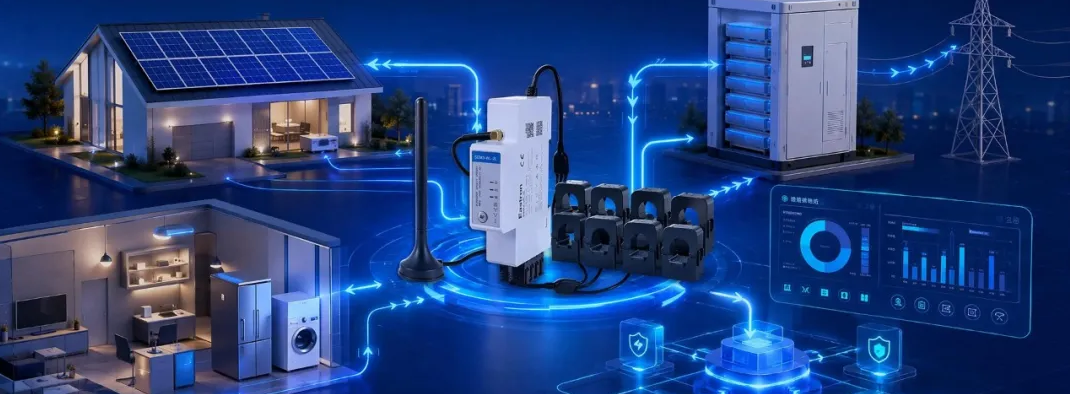
Eastron SEM-2L Series:
Supports four-quadrant bidirectional metering, covering various operating states such as PV generation, load consumption, and energy storage charge/discharge.
Supports dual-channel metering, enabling simultaneous monitoring of multi-circuit equipment to meet coordinated metering requirements.
Features a 50ms high-speed data refresh rate, providing real-time data support for peak-valley arbitrage and intelligent scheduling.
Supports Wi-Fi and RS485 communication, allowing integration with EMS and BMS systems for intelligent energy management.
As PV and energy storage systems increasingly converge, electricity meters are evolving from simple metering devices into foundational data nodes for energy systems.
Eastron offers smart meter solutions tailored to residential PV, C&I PV, and micro-storage application scenarios, meeting the diverse needs of different systems.
From precise metering and communication integration to energy management support, Eastron is committed to helping customers achieve more reliable data acquisition, more efficient energy management, and more stable system operation.
Your email address will not be published. Required fields are marked *

We develop and produce high performance electricity meters, power analyzers, current sensors, communication modules and management systems.
Address:NO. 52, Dongjin Road, Nanhu, Jiaxing, Zhejiang, China
Copyright @ Eastron Electronic Co., Ltd. All rights reserved
