

 English
 Español
 Deutsch
 中文简体
中文简体
Product Consultation
Your email address will not be published. Required fields are marked *
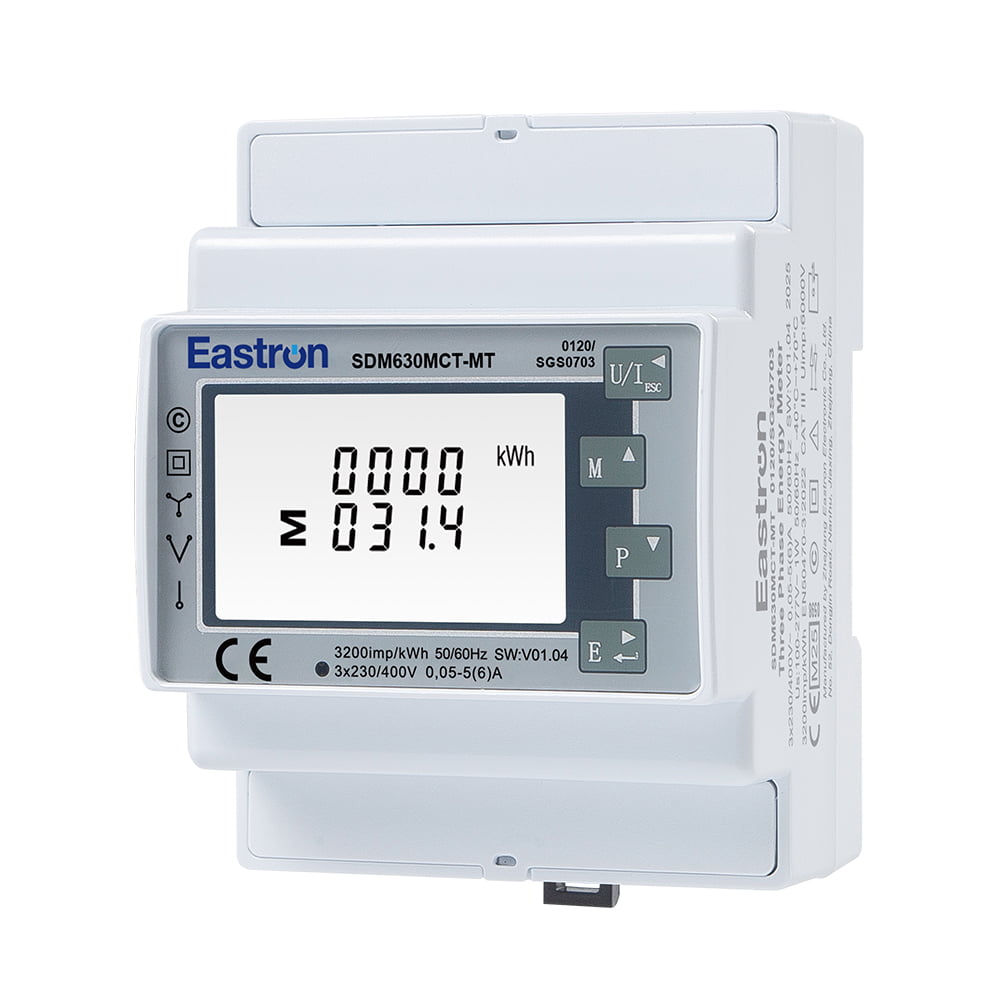
UL and ETL Listed Energy Meters: Safety Certification, Applications, and Buying Guide
Sep 21,2026
Smart Meter FAQ (Part 3) | Certification, Installation, and Procurement: Addressing 5 Practical Application Issues
Sep 20,2026
National Quality Month | A Look Inside Eastron Electronic: Quality Embedded in Every Stage
Sep 20,2026Content
A single phase multifunction energy meter is an advanced electrical measurement instrument designed to simultaneously monitor, calculate, and display a comprehensive range of power quality and energy parameters from a single-phase AC power supply. Unlike a basic kilowatt-hour (kWh) meter that records only cumulative energy consumption, a multifunction energy meter captures instantaneous values of voltage, current, active power, reactive power, apparent power, power factor, frequency, and harmonic distortion — often updating these readings multiple times per second and making them available via a front-panel display, digital communication ports, or pulse outputs.
These meters are widely deployed in residential distribution boards, commercial tenant sub-metering systems, industrial machine monitoring panels, renewable energy installations, and building energy management systems (BEMS). Their ability to consolidate what previously required multiple separate instruments — a voltmeter, ammeter, power factor meter, frequency meter, and energy totalizer — into a single compact DIN rail or panel-mount unit significantly reduces installation complexity, wiring cost, and panel space requirements while delivering far richer data for energy analysis and billing purposes.
The defining characteristic of a multifunction meter is the breadth of parameters it can measure from a single set of voltage and current inputs. Understanding what each parameter represents helps users extract maximum value from the meter's data output.
The meter continuously measures RMS (root mean square) voltage across the live and neutral terminals and RMS current through the measured circuit, either directly for loads up to the meter's rated current — typically 5A, 10A, 32A, 63A, or 100A depending on the model — or indirectly via an external current transformer (CT) for higher current circuits. Voltage measurement accuracy is typically Class 0.5 or better, meaning the reading error does not exceed 0.5% of the actual value under reference conditions. Monitoring voltage is essential for detecting supply undervoltage or overvoltage conditions that can damage sensitive equipment and void equipment warranties.
Active power (measured in watts, W) is the real power consumed by resistive loads and converted into useful work such as heat, light, or mechanical motion. Reactive power (measured in volt-amperes reactive, VAR) is the power exchanged between the supply and inductive or capacitive loads — such as motors, transformers, and fluorescent lamp ballasts — that does no useful work but occupies network capacity. Apparent power (measured in volt-amperes, VA) is the vector sum of active and reactive power and represents the total electrical loading placed on the supply conductors and protective devices. Tracking all three values enables facility managers to assess true loading, identify reactive power penalties on electricity bills, and size power factor correction equipment correctly.
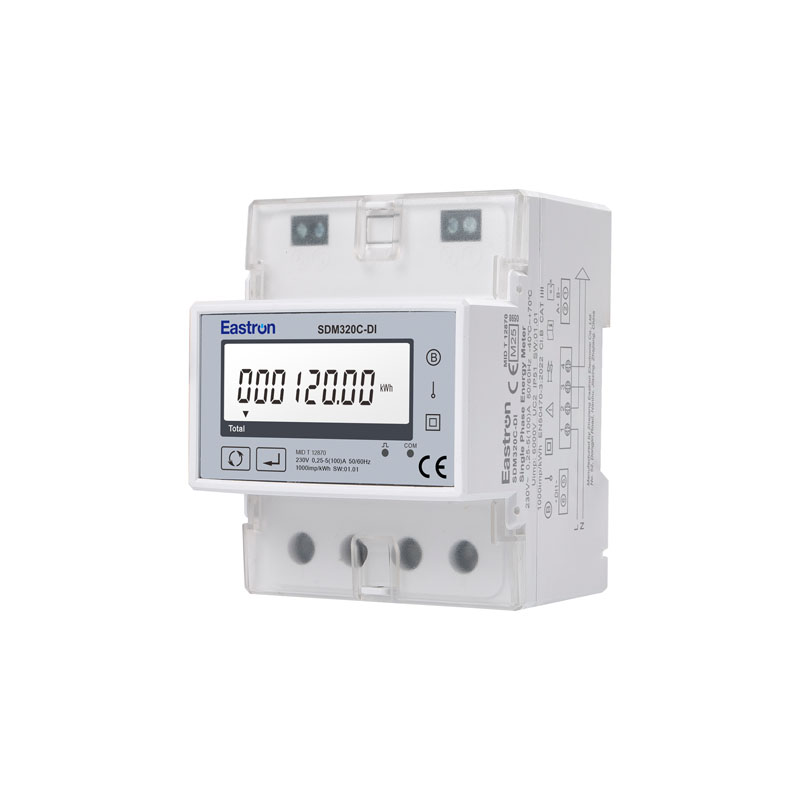
Power factor (PF) is the ratio of active power to apparent power, expressed as a dimensionless number between 0 and 1 or as a percentage. A power factor of 1.0 (unity) means all the current drawn is doing productive work; a power factor of 0.7 means only 70% of the current is productive, with the remaining 30% circulating as reactive current that heats cables and transformer windings without delivering energy. Many utility tariffs impose reactive power charges or low-power-factor penalties on commercial and industrial consumers, making real-time power factor monitoring commercially significant. Frequency measurement — typically displayed to two decimal places around the nominal 50 Hz or 60 Hz — provides insight into grid stability and is particularly relevant in sites with local generation or UPS systems.
Active energy (kWh) import and export registers allow the meter to function as a revenue-grade or sub-metering instrument for billing tenants, cost-center allocation, or net metering of solar photovoltaic generation. Reactive energy (kVARh) registers support reactive power billing and power factor correction analysis. Advanced multifunction meters also measure total harmonic distortion (THD) of both voltage and current waveforms, and some models provide individual harmonic components up to the 31st or 63rd order — critical data for diagnosing power quality problems caused by variable speed drives, switched-mode power supplies, and nonlinear electronic loads.
The accuracy of a single phase multifunction energy meter is defined by its compliance with international measurement standards, which specify the maximum permissible error under defined test conditions. Selecting the appropriate accuracy class for the application avoids overpaying for precision that is not needed or accepting errors that compromise billing integrity or energy analysis.
| Accuracy Class | Max Error (Active Energy) | Typical Application |
| Class 2 | ±2% | General energy monitoring, indicative metering |
| Class 1 | ±1% | Sub-metering, cost allocation, energy auditing |
| Class 0.5S | ±0.5% | Revenue metering, utility billing, CT-connected systems |
| Class 0.2S | ±0.2% | Reference metering, laboratory, grid interconnection |
The governing standards for single phase multifunction energy meters include IEC 62053-21 and IEC 62053-22 for active energy measurement accuracy, IEC 62053-23 for reactive energy, and IEC 61557-12 for performance requirements of multifunction measurement instruments. In North America, ANSI C12.20 defines accuracy requirements for revenue-grade metering. Meters intended for official utility billing in many countries must additionally carry national pattern approval or type approval certification from the relevant metrology authority — such as MID approval in Europe under the Measuring Instruments Directive 2014/32/EU.
One of the most important differentiators between multifunction energy meters is their communication capability. The ability to transmit measured data to external systems — building management systems, SCADA platforms, energy management software, or cloud-based monitoring portals — is what transforms a multifunction meter from a local display instrument into a node in a broader energy intelligence infrastructure.
Modbus RTU over RS-485 is the most universally supported communication protocol in industrial and commercial energy metering. It allows multiple meters — up to 247 devices on a single RS-485 bus — to be polled by a master device such as a PLC, data logger, or building automation controller. Each meter is assigned a unique Modbus address, and all measured parameters are mapped to specific register addresses that the master reads on demand. RS-485 wiring is robust, supports cable runs of up to 1200 meters, and is well understood by installation engineers worldwide, making Modbus RTU the baseline communication option for any sub-metering deployment.
Meters with an integrated Ethernet port running Modbus TCP or other TCP/IP-based protocols can connect directly to a local area network, making their data accessible to any networked device without a dedicated serial communication infrastructure. This is particularly convenient for commercial buildings with existing Ethernet cabling and for integration with web-based energy management platforms. Some meters support MQTT protocol over Ethernet for direct publishing of measurement data to cloud IoT brokers, enabling real-time energy dashboards without a local server.
Pulse outputs generate a digital pulse for each defined quantity of energy consumed — for example, one pulse per 0.1 kWh or one pulse per 1 kWh. These pulses can be counted by a PLC digital input, a data logger pulse counter, or a building management system to calculate energy consumption without requiring a serial communication interface. Pulse outputs are simple, universally compatible, and highly reliable, making them the preferred integration method for connecting multifunction meters to legacy building management systems that predate modern serial communication standards.
An increasing number of single phase multifunction meters now incorporate wireless communication modules — including Wi-Fi, Zigbee, LoRaWAN, NB-IoT, or 4G LTE — that eliminate signal wiring entirely. These wireless meters are particularly valuable in retrofit installations where running new communication cables is impractical, in distributed monitoring applications across multiple buildings, and in smart home energy management systems where the meter connects directly to a home Wi-Fi router and a consumer-facing energy monitoring app.
Single phase multifunction energy meters are manufactured in several physical formats to accommodate different installation environments and panel configurations.
The versatility of single phase multifunction energy meters means they serve a broad range of measurement and billing functions across residential, commercial, and industrial sectors.
With dozens of manufacturers offering hundreds of models, narrowing down the selection requires a clear understanding of the measurement requirements, integration environment, regulatory context, and budget constraints of the specific project.
Your email address will not be published. Required fields are marked *

We develop and produce high performance electricity meters, power analyzers, current sensors, communication modules and management systems.
Address:NO. 52, Dongjin Road, Nanhu, Jiaxing, Zhejiang, China
Copyright @ Eastron Electronic Co., Ltd. All rights reserved
