

 English
 Español
 Deutsch
 中文简体

Product Consultation
Your email address will not be published. Required fields are marked *
Content
If you have spent any time specifying meters for DC installations, you already know that the headline number on a datasheet is rarely the whole story. A 1000 V DC energy meter sits at the edge of a fast-moving part of the market: DC fast chargers, battery racks, test benches and small DC microgrids, all running bus voltages that would have looked unusual in a building panel a decade ago. What follows is written from the practical side of that work, the questions we tend to get asked when engineers, integrators and procurement teams are narrowing a model down to a part number.
On most DIN rail DC meters, "up to 1000 V DC" describes the voltage input range of the measuring channel, not the entire electrical envelope of the product. Three details deserve a second look before that figure gets treated as a green light.
The largest single application is DC charging for electric vehicles. A charger that bills by the kilowatt hour needs a meter whose accuracy is defensible, whose data can be read by the controller, and in many markets whose approval is recognised by the regulator. Our own work in EV charging metering has followed that pattern closely, and the same meter family often reappears elsewhere.
Battery energy storage is the second big one. Racks charge and discharge, so the meter has to register energy in both directions and keep import and export in separate registers, otherwise your round-trip efficiency figures will be quietly wrong. Beyond that we see electrolyser skids, DC microgrids on islands and in remote sites, laboratory benches where a 1000 V DC supply is cycled through a device under test, and industrial DC busbars feeding drives. Each has a slightly different priority: billing accuracy in one, fast readable data in another, and simple panel space in a third.
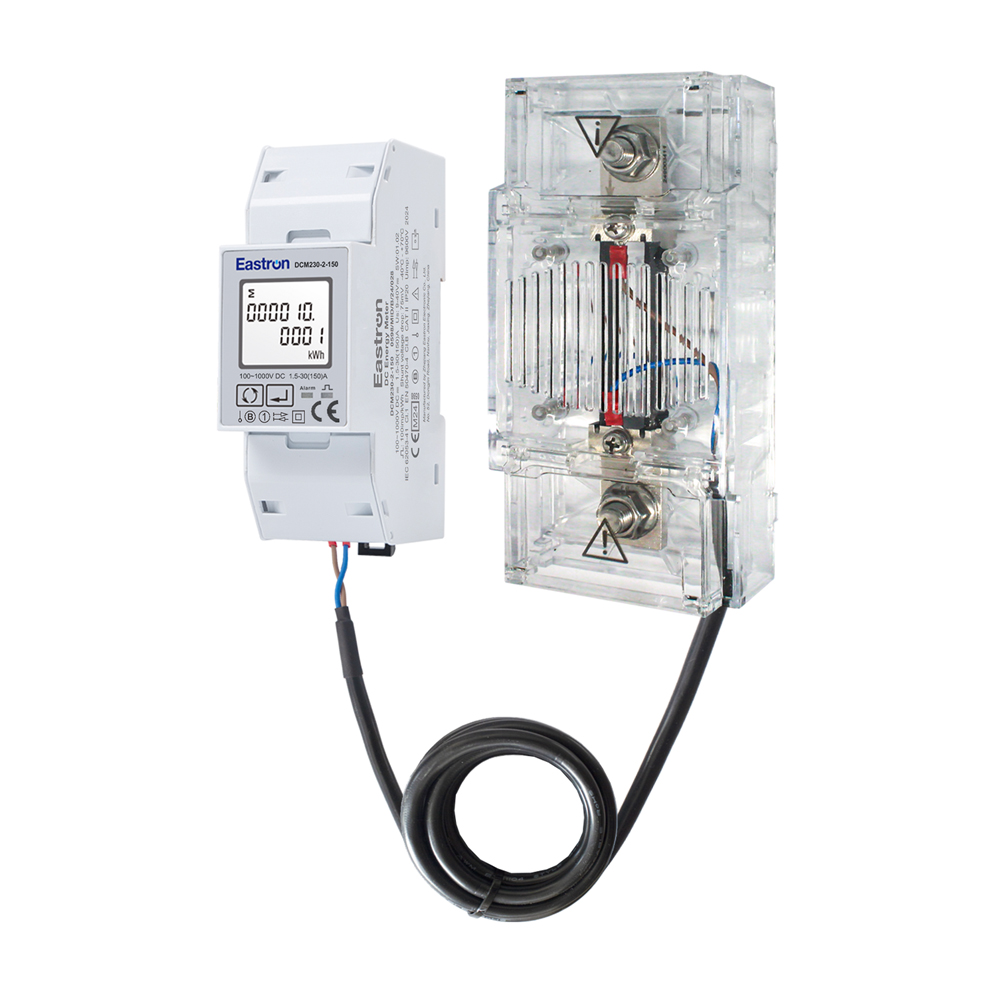
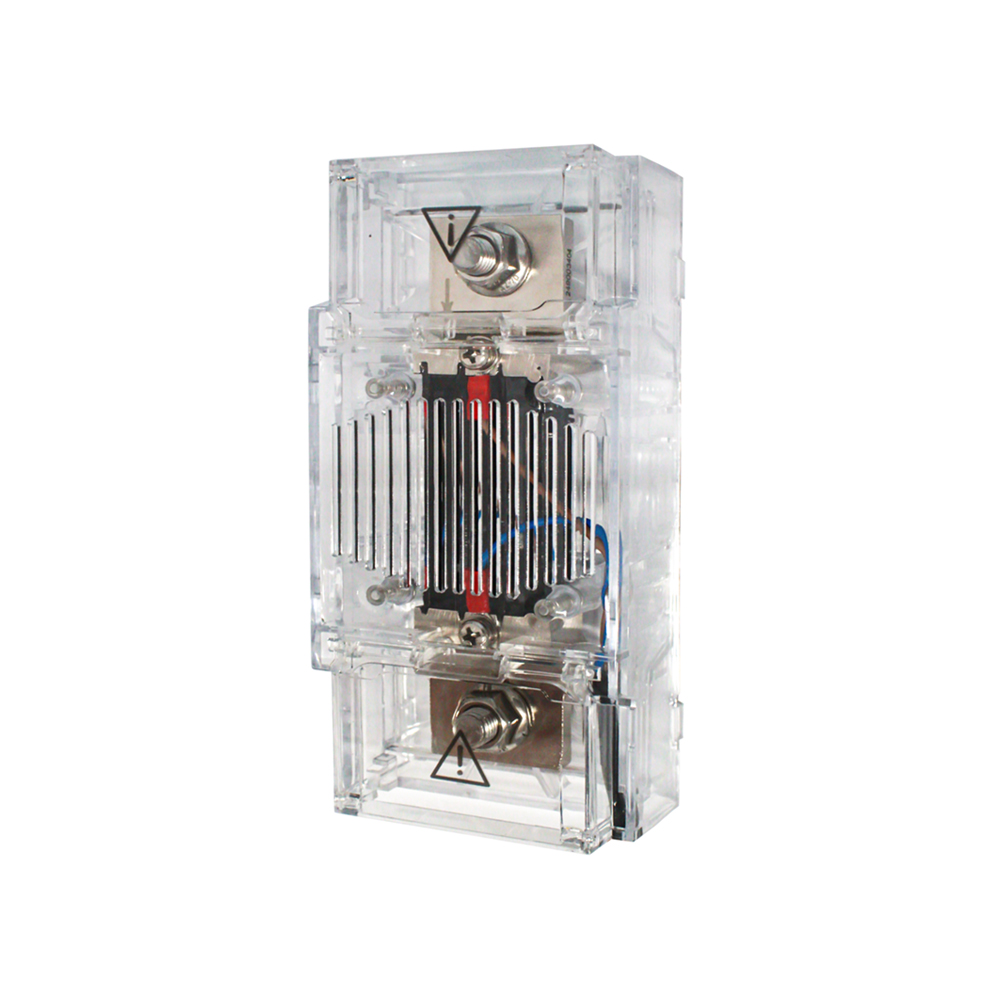
Almost every 1000 V DC meter in this class measures current through a shunt, usually a 75 mV output device, and the quality of that connection decides the quality of your kWh figures. The internal shunt versions are compact and take the heavy cabling directly, which suits chargers in the 150 to 200 A range. External shunt versions push the measurement point out to a busbar-mounted resistor and let you cover 300 A, 600 A and beyond without running thick cable into a DIN module.
Two practical points come up again and again. First, use a four-wire Kelvin connection to the shunt, and keep the sense leads short and twisted; a fraction of an ohm in the sense path becomes a visible offset at high current. Second, check the shunt's temperature behaviour and its continuous current rating rather than its peak rating, because a shunt that runs hot will drift, and no amount of firmware linearisation will fully recover the reading.
 Eastron DCM230-2-400 400A DC Energy Meter with ShuntDIN-rail DC meter for 100–1000V systems, with 400A shunt connection, Modbus RTU and bi-directional energy measurement for EV charger monitoring.View Product →
For lower-power installations where the whole load passes through the module, the same platform is available as a compact single-load unit with an integrated shunt and Modbus output, which keeps cabinet wiring to a minimum.
Dual-channel DC meters are not simply two meters in one box. In a charger with separate charge and discharge paths, or a storage cabinet where you want to see the DC input and the DC output side by side, a two-channel meter gives you a common time base and a single communication address. That makes reconciliation easier and cuts the number of RS485 nodes on the bus.
The trade-off is straightforward: two channels share one enclosure, one supply and one set of terminals, so plan the wiring and labelling before you order. If the two circuits have very different current ranges, check whether the channels can be configured independently, and whether the second channel needs its own external shunt.
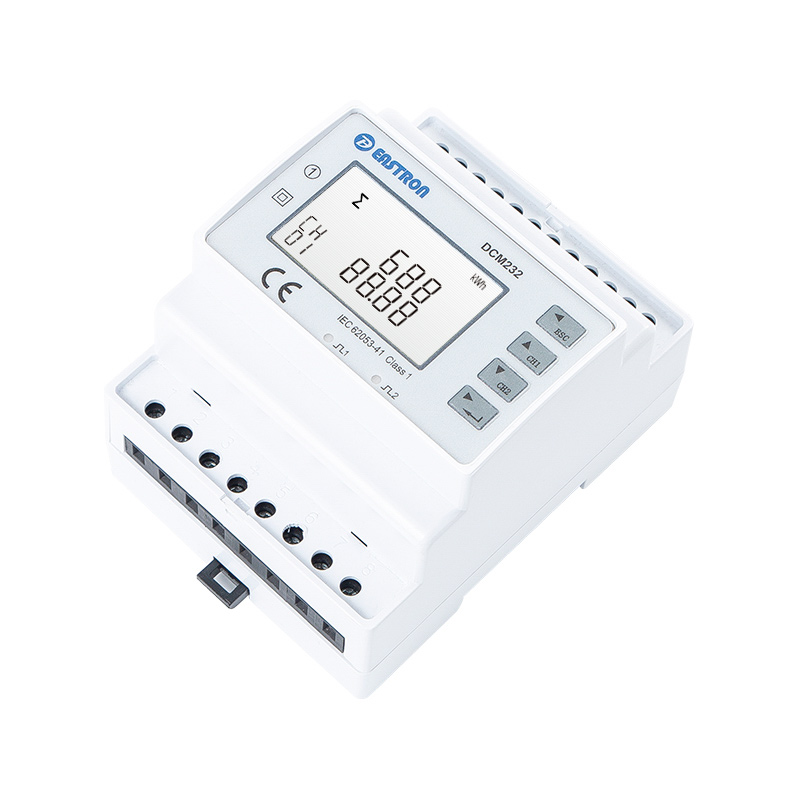 DCM232 Dual-Channel DIN-Rail DC Energy MeterDual-channel DIN-rail meter for 5–1000V DC systems, with shunt input, import/export energy measurement and RS485 Modbus RTU.View Product →
The table below summarises the shapes we see most often in enquiries. Treat it as a starting point for the specification conversation, not as a substitute for the datasheet.
| Configuration | Current range | Voltage input | Communication | Usual application |
|---|---|---|---|---|
| Single load, integrated shunt | 150 to 200 A | Up to 1000 V DC | RS485 Modbus RTU | Wall-mounted DC chargers, small storage |
| Single load, external shunt | Up to 600 A | Up to 1000 V DC | RS485 Modbus RTU or DLT645 | High-power chargers, busbar feeds |
| Dual channel | Two independent channels | Up to 1000 V DC | RS485 Modbus RTU | Charge and discharge paths, twin dispensers |
| Billing-grade variant | 150 to 600 A | Up to 1000 V DC | RS485 Modbus RTU | Public charging with MID or PTB approval |
Most 1000 V DC meters in this class speak Modbus RTU over RS485, with DLT645 appearing in some markets and Ethernet variants available where a TCP path is preferred. Baud rate and framing are usually configurable, and 9600 or 19200 with 8N1 is a sensible default for a long daisy chain.
The details that cause trouble later are rarely the protocol itself. They are the scaling factors, the signed representation of bidirectional energy, and the register that tells you whether the reading is stale. Build the register map into the project documentation with its version number, and re-check it whenever a firmware revision changes. Our download library keeps user manuals, datasheets and protocol documents for each series, which is the version we would point a commissioning engineer to rather than an old copy on a shared drive.
If the measurement is used for billing, the approval often narrows the shortlist faster than any technical parameter. In the European Union, MID approval is the usual baseline for trade use. In Germany, the MessEV framework and its Eichrecht requirements add a further layer, particularly around how measured values are transmitted and protected. In North America, UL or ETL listing is what the inspector will ask for. Each scheme approves a specific configuration, which is why the certificate has to match the part number, the included or excluded shunt, and sometimes the cable lengths.
Where billing accuracy is the deciding factor, the MID-certified 300 A variant with an external DC shunt is a common starting point for charger projects in Europe.
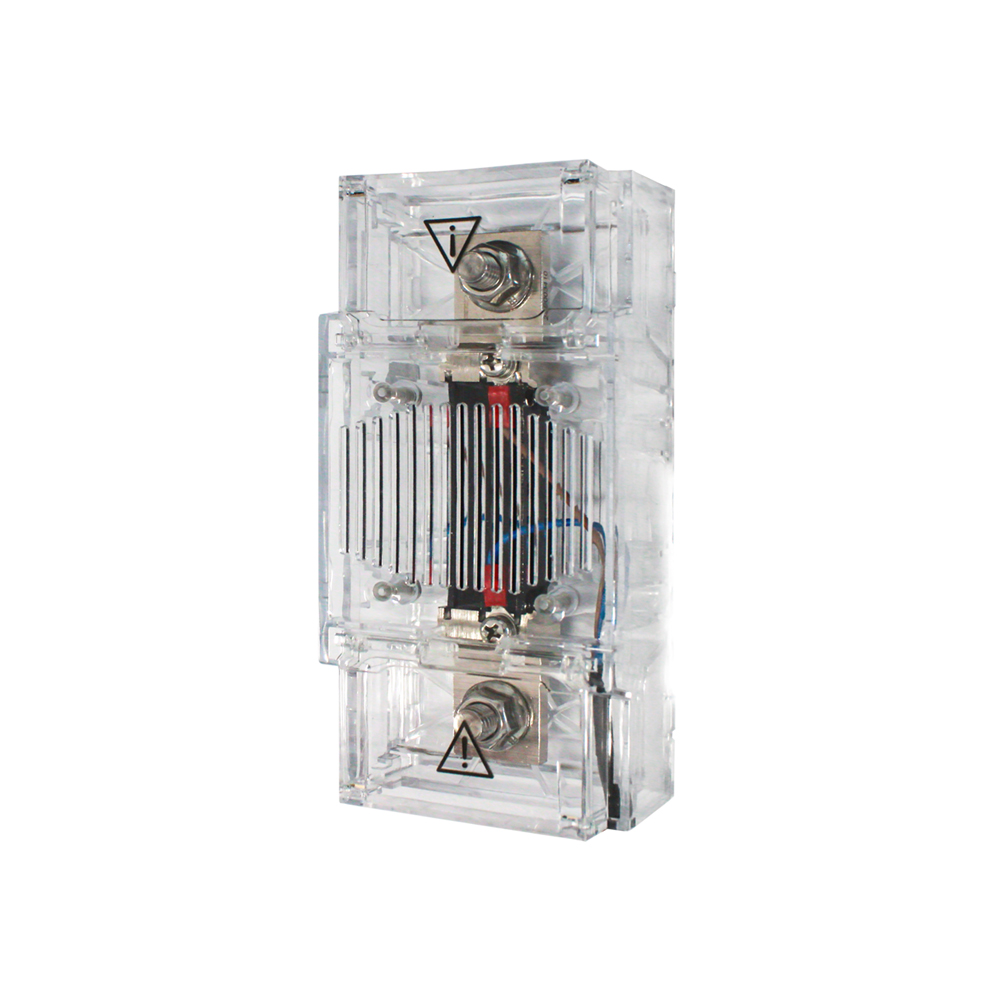 MID-Certified Eastron DCM230-2-300 300A DC Energy MeterMID-approved DIN-rail meter for 100–1000V DC systems, with 300A external shunt, Modbus RTU and bi-directional energy measurement for EV charger billing.View Product →
A short list that has saved more than one site visit:
A 1000 V DC energy meter is a small component in a large system, but it is often the one component whose numbers end up on an invoice or in a performance report. Getting the voltage margin, the shunt arrangement, the channel count and the approval scope right at specification stage costs an afternoon. Getting them wrong tends to cost a return visit, a reconfiguration, and a conversation with whoever signs off the billing. If you are weighing up options for a specific project, the datasheets and protocol documents are the fastest way to check that the model in front of you matches the job.
Your email address will not be published. Required fields are marked *

We develop and produce high performance electricity meters, power analyzers, current sensors, communication modules and management systems.
Address:NO. 52, Dongjin Road, Nanhu, Jiaxing, Zhejiang, China
Copyright @ Eastron Electronic Co., Ltd. All rights reserved
